Andean Hillstar — History & Facts
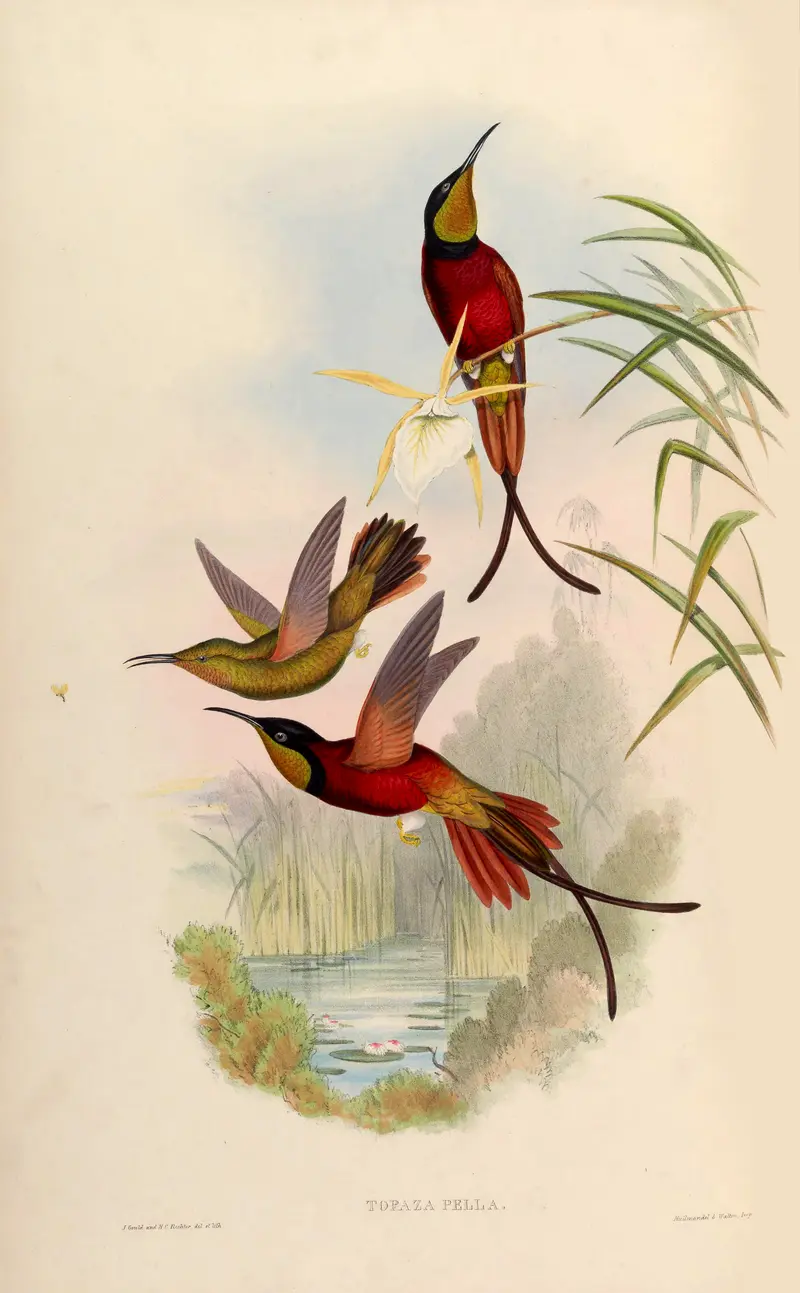
What first catches the eye in Andean Hillstar is the delicate balance between life and landscape: two hummingbirds, poised among spindly blossoms, seem to hover between the earth and the sky itself. The artist draws you in with a gentle diagonal—one bird perched, its throat lifted toward a trumpet-shaped flower, while its companion hovers mid-flight, wings caught in a moment of shimmering pause. The snowy peaks in the distance are rendered with the faintest wash, their pale presence a reminder of the high-altitude world these birds inhabit.
Every detail, from the iridescent green on the birds’ crowns to the curling petals of the flowers, is a study in precision and restraint, guiding the viewer’s gaze in a slow spiral from the birds to the blooms and back again. This work belongs to a tradition of nineteenth-century natural history illustration, where art and science met on the page. John Gould, whose name is linked to some of the era’s most celebrated bird books, worked alongside a team of artists and lithographers to document species newly described to European science. The date 1861 places this image at the height of Victorian fascination with the natural world, a time when explorers and collectors sent specimens back from remote Andes valleys to be catalogued, drawn, and admired.
The reworking of this image in 2010 hints at a continued appreciation for these luminous records of discovery. Even now, the crisp silhouette of the Oreotrochilus estella against the pale mountains invites viewers to linger, searching for the boundary between observation and wonder.