Guianan Toucanet — History & Facts
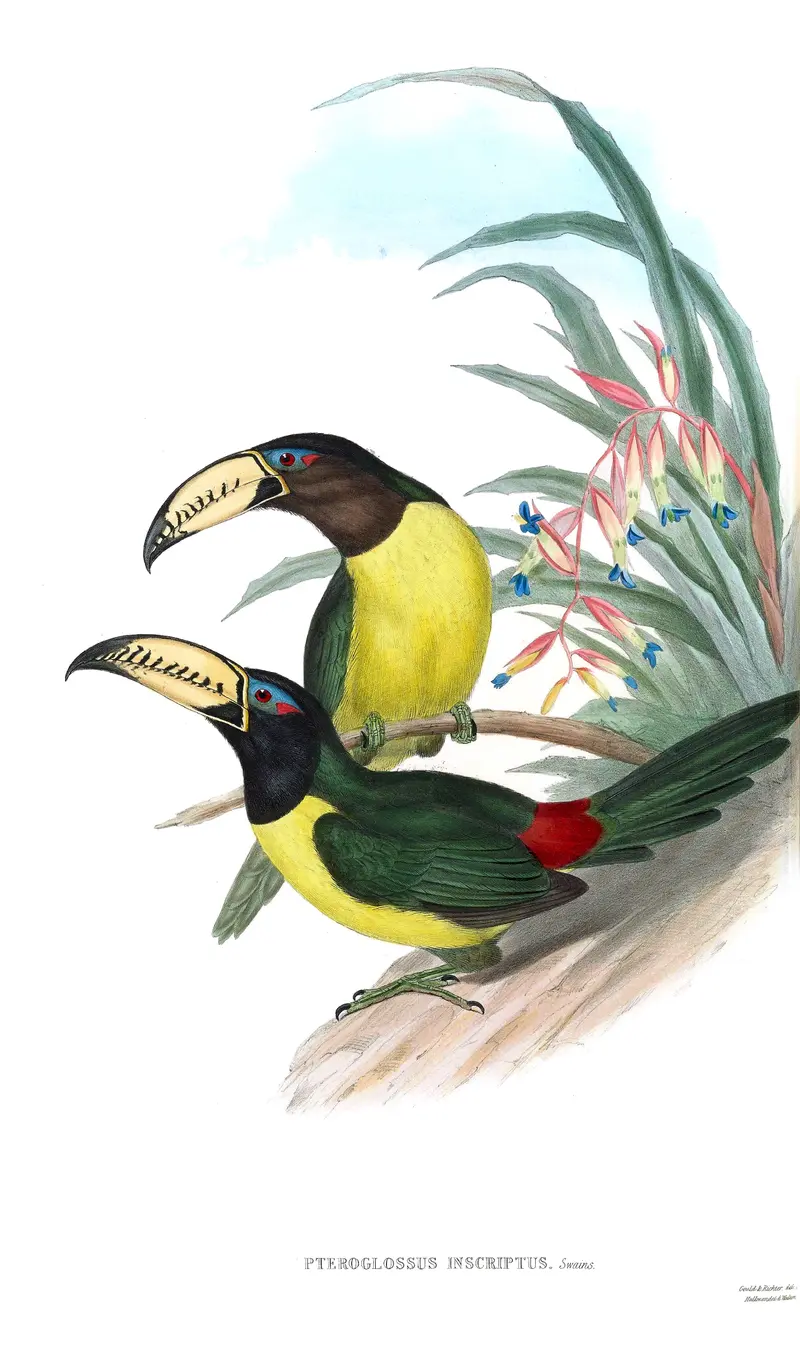
What first catches the eye in Guianan Toucanet is the sense of alertness and curiosity in the birds’ posture, as if the viewer has stumbled upon a private moment in the dense foliage. The two toucanets are rendered with a sharpness that makes their plumage almost tactile: the deep green wings, the yellow flashes at the head, and the striking red at the beak’s base all draw the gaze in quick succession. One bird leans forward, its beak slicing into the white space, while the other hovers behind, half-shielded by a broad, pale leaf.
The composition pulls the viewer’s attention along the arch of the branch, inviting a closer look at the subtle gradations of color and the careful delineation of claw and feather. The background, softly washed in blue and green, lets the birds claim the foreground entirely, heightening their vividness and the sense of immediacy. Created in 1854 for A Monograph of the Ramphastidæ, Or Family of Toucans, this illustration by John Gould belongs to a golden age of natural history art, when explorers and scientists sought to capture the world’s diversity on the page. Such works were not merely decorative; they were crucial tools for study and classification, often commissioned by wealthy patrons or scientific societies eager to catalogue the wonders brought back from distant lands.
Gould’s plates are celebrated for their blend of scientific accuracy and artistic flair, and this example—published in London by Taylor and Francis—reflects both the precision and the romance of Victorian ornithology. History has kept few traces of the individual journeys of these images, but their purpose remains clear: to bring the vibrant, unfamiliar life of the tropics into the drawing rooms and libraries of Europe. Let your eye linger on the details, and imagine the world of discovery that once unfolded around them.