Tawny Owl — History & Facts
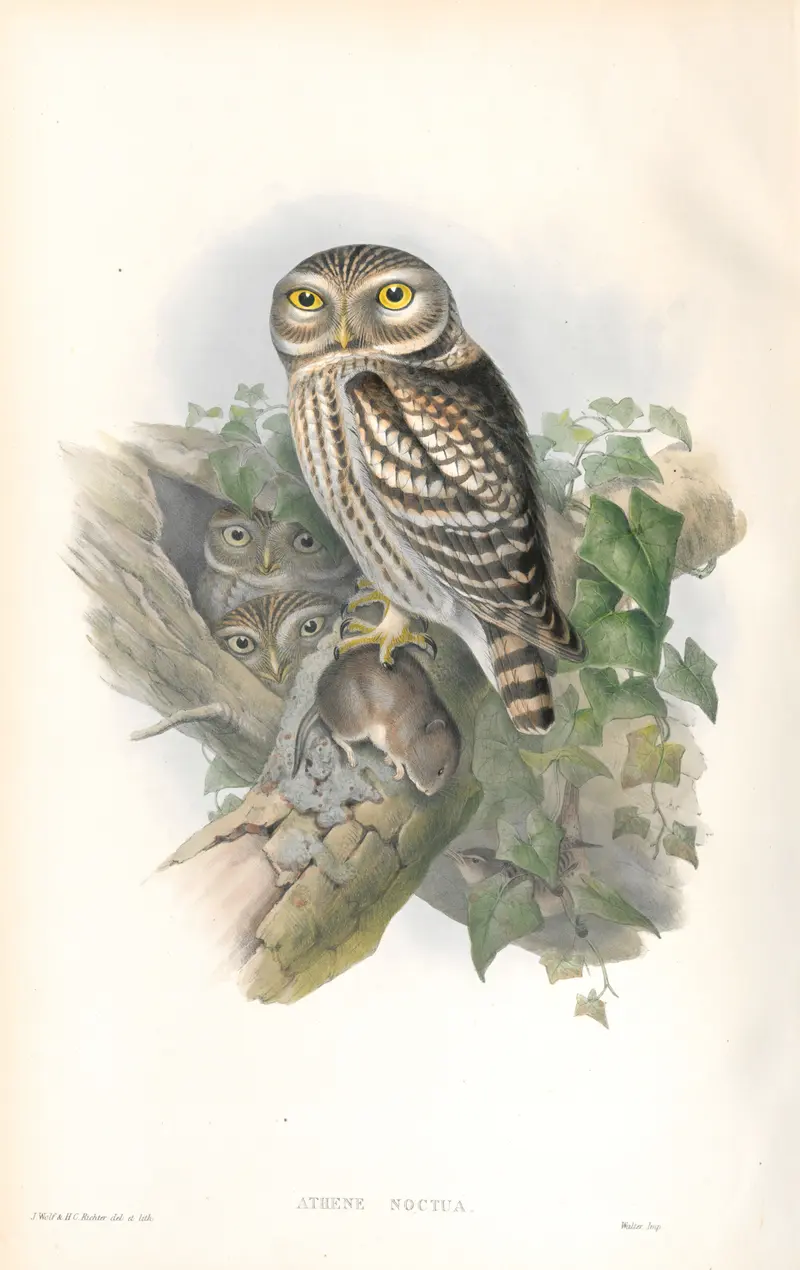
The first thing to catch the eye in Tawny Owl by John Gould is the intense, almost human gaze of the owl in the foreground, its head cocked in a gesture of alertness and care. The artist draws us in with the drama of the moment: a parent owl, prey clutched in its beak, pauses at the edge of a hollow tree. Below, two downy chicks peer up from the dark, their round faces echoing the adult’s but marked by the vulnerability of youth.
Every feather is rendered with a precision that rewards close looking, the warm chestnut and cream tones set off by the cool, shadowed wood and the soft green of oak leaves. The composition guides the viewer’s eye in a gentle arc, from the watchful mate above, through the main figure, and down to the nestlings—each detail reinforcing the sense of a family drama unfolding in the quiet of the woods. This illustration belongs to the grand tradition of 19th-century natural history, when artists like John Gould brought the wonders of the animal world to a public hungry for knowledge and beauty. Created for Gould’s monumental "The Birds of Great Britain," published in London in 1873, works like this were both scientific documents and objects of wonder, commissioned to educate and delight.
The precision of the drawing speaks to an era when naturalists and artists often worked side by side, striving to capture not just the appearance but the life of their subjects. History has kept few traces of the individual journeys of such plates, but their collective impact is unmistakable: they shaped how generations saw and understood the living world. Look again at the eyes of the owl—there is both science and a quiet invitation to imagine the forest at dusk.