Greater Bird-of-Paradise — History & Facts
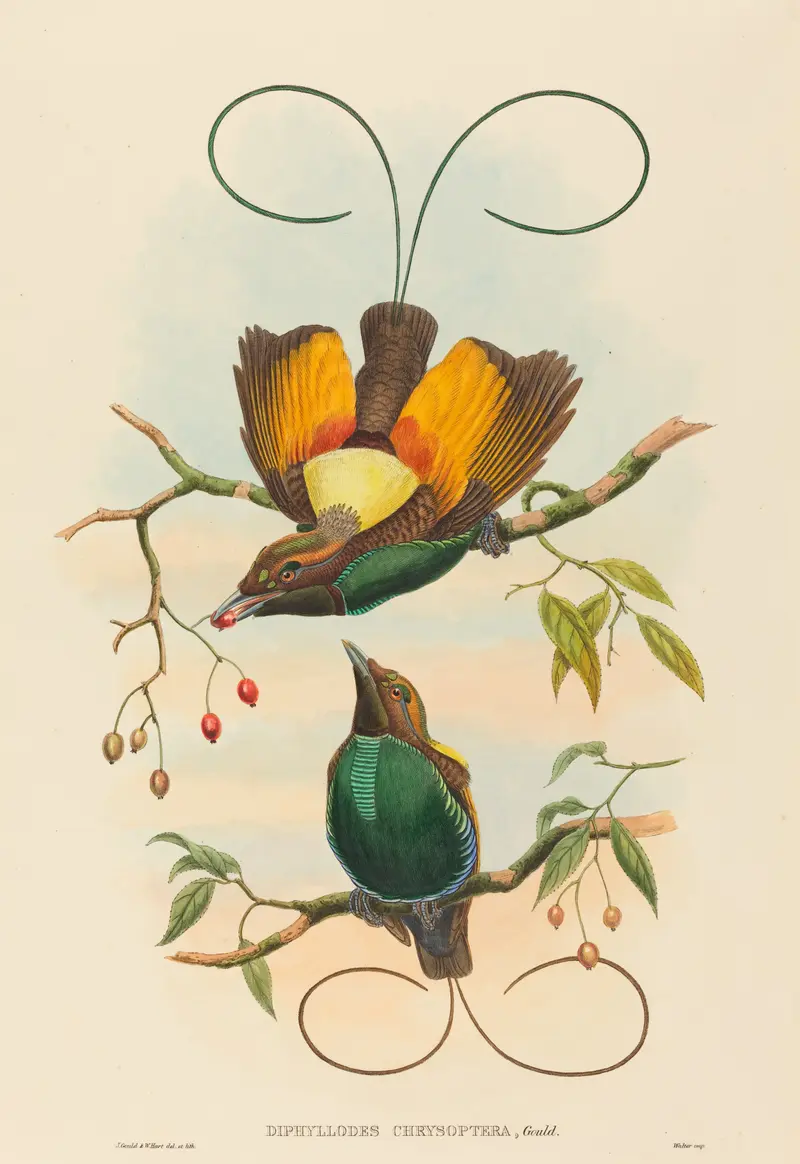
What first catches the eye in Greater Bird-of-Paradise by John Gould is the explosion of gold and copper feathers that seem to spill off the page, trailing into delicate filaments that almost shimmer against the pale background. The male bird, perched high and alert, clutches a berry in its beak—a flash of red echoing the blossoms that dot the twisting branch beneath him. His companion, more subdued in tone, grounds the composition with her steady gaze and rich brown plumage.
Every feather is rendered with a precision that speaks to hours of close observation, yet the scene feels alive: the curve of the claws gripping the branch, the tilt of the heads, the play of light across the birds' backs. The artist’s hand guides us from the vibrant crown and emerald throat down to the extravagant tail, inviting us to marvel at nature’s inventiveness. Created sometime between 1875 and 1888, this work belongs to the golden age of natural history illustration, when explorers and artists raced to capture the wonders of distant lands for European audiences hungry for the exotic. John Gould was famed for his lavish bird books, which married scientific accuracy with a flair for the dramatic, and works like this were prized by collectors, scholars, and armchair travelers alike.
The National Gallery of Art now holds this image, a testament to the era’s blend of curiosity and spectacle. History has kept few traces of the individual journeys of such illustrations, but their purpose is clear: to astonish, to educate, and to draw the viewer—then as now—into the intricate beauty of the natural world.