Crimson Topaz — History & Facts
What first catches the eye in Crimson Topaz is the sheer vibrancy of the birds’ plumage, rendered with a precision that seems almost to pulse with life. One bird perches on a reed, its long, elegant tail curling downward as it surveys the world with a sharp, alert gaze. Below, two companions dart through the air, their wings caught mid-beat, the feathers flashing with fiery reds and deep golds.
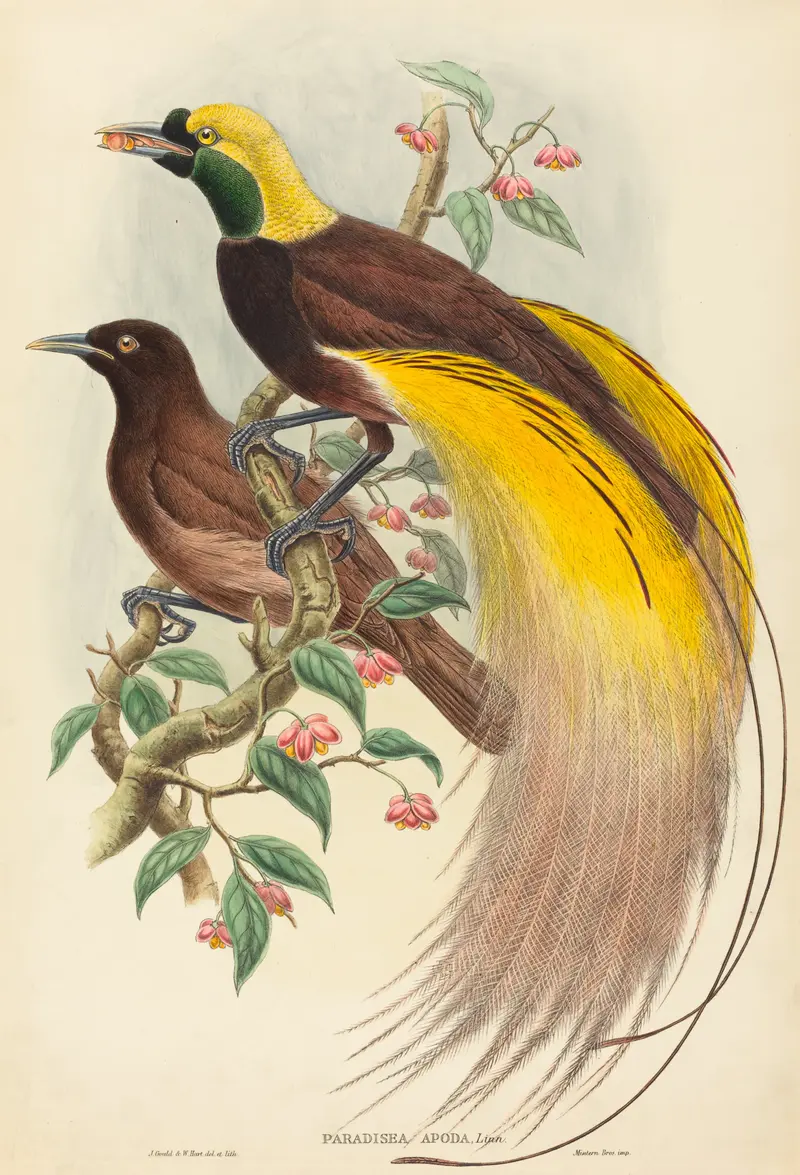
The artist has set these hummingbirds against a soft, misty background of reeds and water lilies, letting the lush colors of the birds leap forward. Every detail—the iridescent throat, the fine gradation of green on the wings, the delicate arch of the beak—serves to celebrate the extraordinary beauty of a creature often glimpsed only in motion. This work belongs to the golden age of natural history illustration, when explorers and artists like John Gould sought to capture the wonders of the natural world for a European audience hungry for discovery. Published in 1861 as part of Gould’s monumental study of hummingbirds, this image of Topaza pella—the Crimson Topaz—reflects both scientific ambition and artistic flair.
Such illustrations were prized by collectors and scholars alike, serving as both records and marvels in an era before color photography. History has kept few traces of the individual journeys of these images, but their purpose is clear: to bring the dazzling, far-off world of the tropics into the drawing rooms and libraries of Victorian Britain. Look again, and you may glimpse the sense of awe that first inspired their making.