Magnificent Bird-of-Paradise — History & Facts
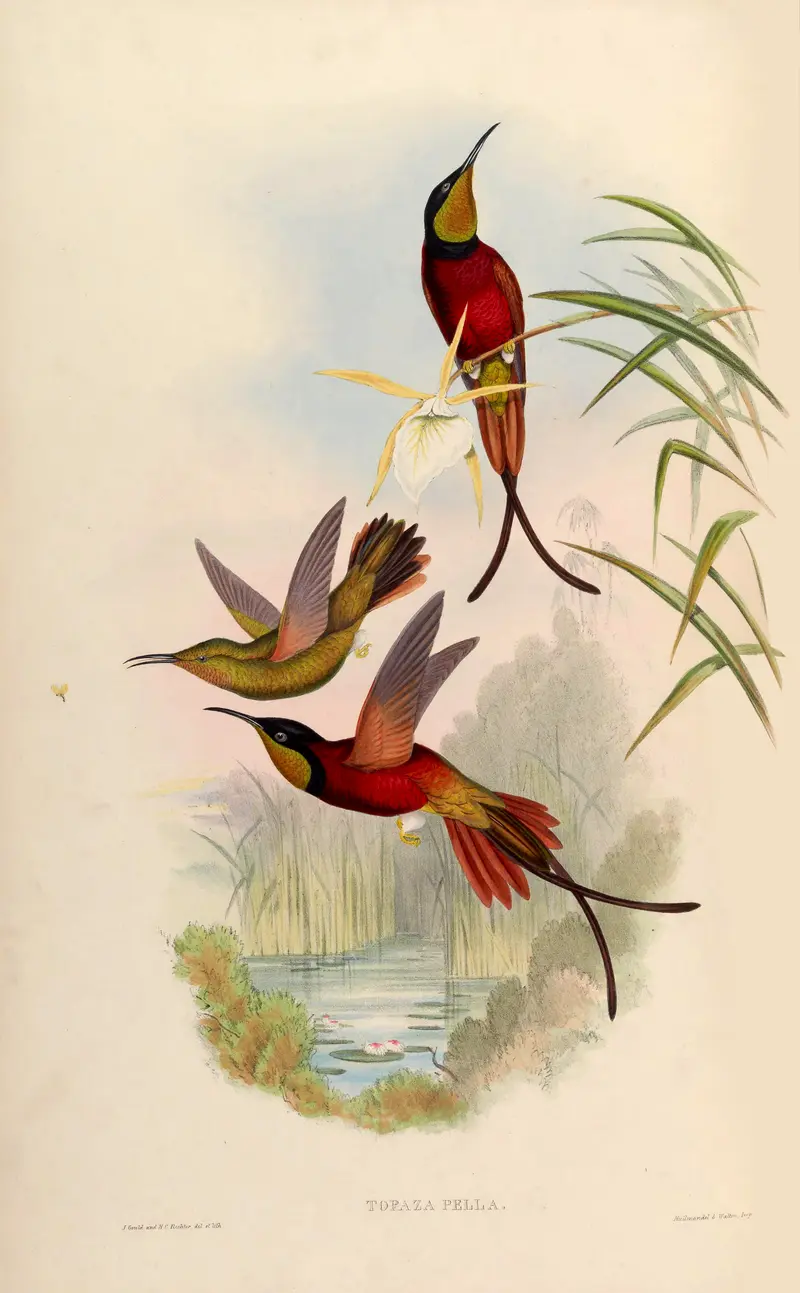
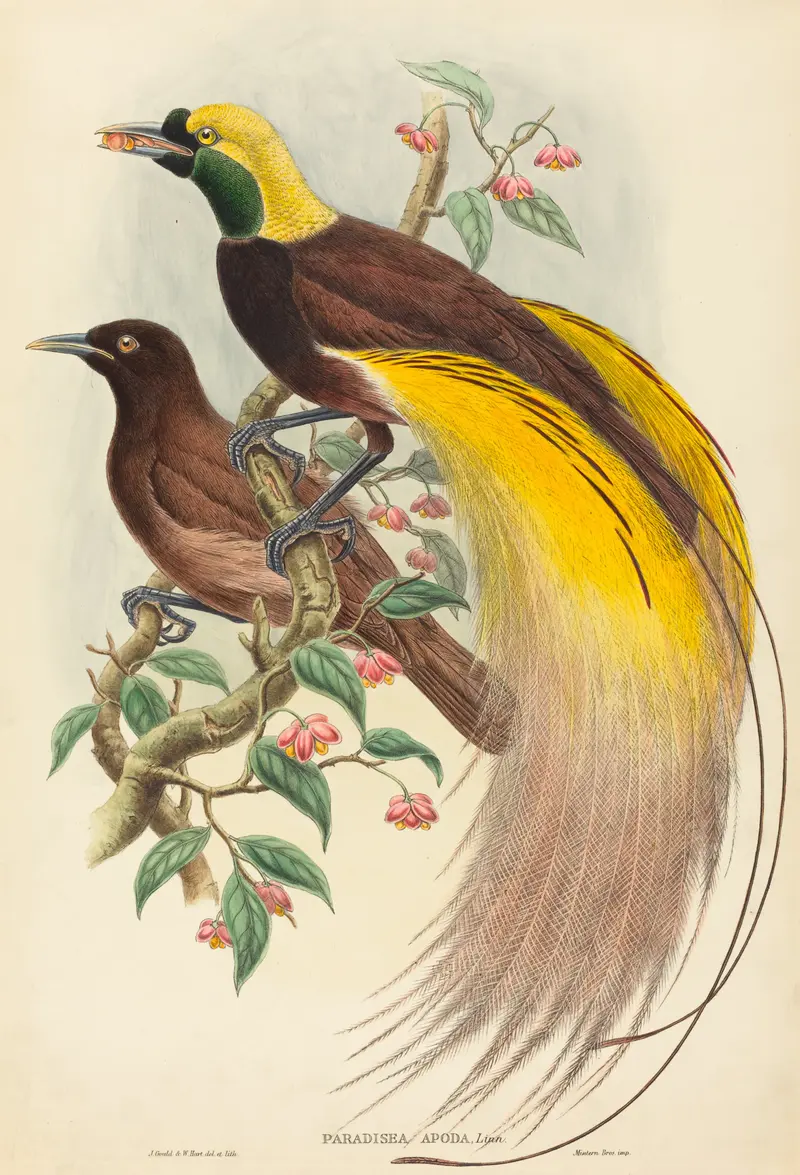
The eye is caught first by the impossible flourish of feathers—two birds poised in a dance of color and display, their tails curling in elegant loops that echo the arc of the branch. The top bird, wings flared in a burst of yellow and orange, reaches for a berry, while its companion below sits in vivid green, chest thrust forward, as if ready to sing. The artist’s hand lingers on every detail: the iridescent shimmer of the breast, the crisp edge of each feather, the precise curve of beak to fruit.
Light washes the background in pale blue and peach, setting the birds apart like jewels against a quiet sky, and the composition draws the viewer’s gaze in a slow spiral from the fruit, through the birds, to the delicate script below. Works like this, attributed to John Gould, belong to a golden age of natural history illustration in the nineteenth century, when explorers and scientists raced to catalogue the wonders of distant continents. Such images were not merely decorative; they served as vital records for scholars and collectors, often commissioned for lavish folios or scientific treatises. The Magnificent Bird-of-Paradise—with its extravagant plumage and theatrical pose—embodies the fascination with the exotic that swept through Victorian Europe.
This particular work, now shared by the National Gallery of Art as part of an open access initiative, stands as a testament to both the artistry and the curiosity of its era. Let your gaze linger on the birds’ impossible tails and the careful gradation of color, and imagine the sense of discovery these images once inspired.