
Battle of Medway — History & Facts
The sun casts a warm glow over the chaotic scene, illuminating the rippling waters of the Medway as soldiers clash in a desperate struggle for dominance. The air is thick with tension, shouts mingling with the clang of metal against metal, while the distant silhouettes of ships loom like ghosts above the fray. Amidst the tumult, a fleeting moment of stillness captures a solitary soldier, his face a mixture of determination and fear, caught between duty and the looming shadows of decay. Look to the lower left corner, where figures are entangled in combat, their bodies defined by a palette of muted earth tones, contrasted sharply against the vibrant blues of the river.
The artist employs dynamic brushwork to convey movement, while the carefully placed highlights catch the reflections on the water’s surface, giving life to the turbulent scene. Notice how Schellinks captures the details of armor and weaponry — tarnished and battered, each piece tells a story of conflict, reinforcing the theme of decay amidst valor. The artwork speaks volumes of dualities: the vitality of battle against the inevitable decline of both the warriors and their vessels. The backdrop of lush greenery hints at life persisting beyond the struggle, yet it's tinged with the foreboding presence of decay, evident in the rusting ships and the weary expressions of the combatants.
Here, victory is overshadowed by the fragility of life, a poignant reminder of how glory can quickly fade into oblivion. Willem Schellinks painted this scene around 1668, during a period when the Dutch were asserting their naval prowess. Living in a time of relative peace following the tumultuous wars, Schellinks was exploring historical themes in his works, blending action and narrative to convey deeper truths about human experience. The Battle of Medway stands as a testament to the artist’s engagement with history, reflecting both the grandeur of conflict and the ever-present shadow of decay that looms over all endeavors.
More Artworks by Willem Schellinks
Browse all →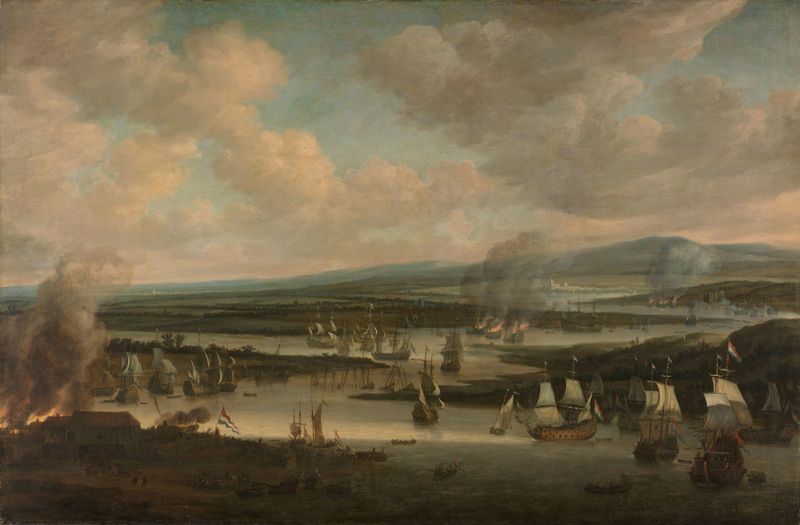
More Historical Art
Browse all →
The Night Watch Militia Company of District II under the Command of Captain Frans Banninck Cocq
Rembrandt van Rijn

Lincoln Memorial
Henry Bacon

The Third of May 1808
Francisco de Goya

Isaac and Rebecca, Known as ‘The Jewish Bride’
Rembrandt van Rijn

The Charge of the Mamelukes (1814)
Francisco de Goya

De vier ruiters van de apocalyps
Albrecht Dürer