Bee Hummingbird — History & Facts
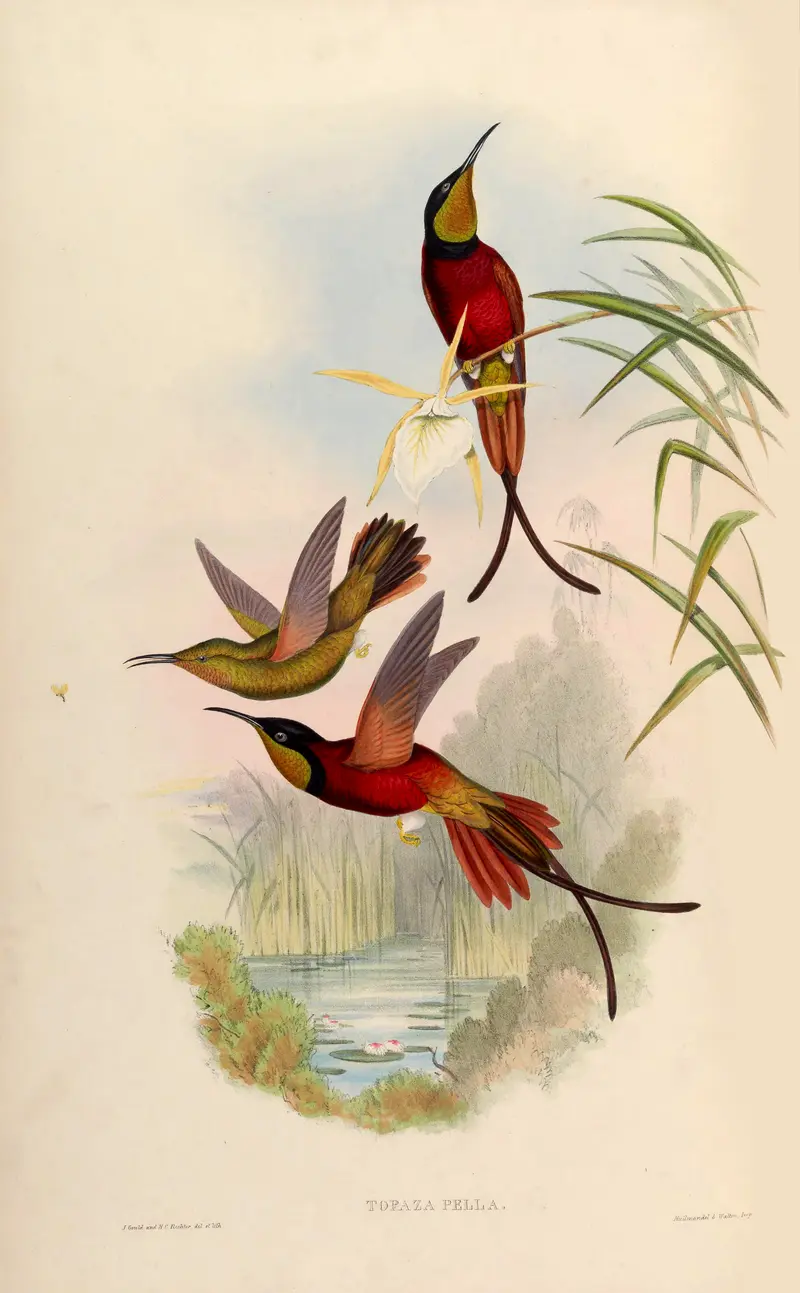
What first catches the eye in Bee Hummingbird is the sense of weightlessness—three birds, each no larger than a thumbprint, seem to hover in a world of pale light and delicate foliage. The artist draws you upward, following the arc of the slender stem, where two of the hummingbirds perch with their scarlet heads bowed toward the blue blossoms, while a third hovers below, wings outstretched in a moment of perfect suspension. The crisp, jewel-like colors of their feathers set them apart from the soft, misty background, a contrast that makes their presence feel both fleeting and vivid.
Every detail, from the glint on a beak to the fine green veins of the leaves, is rendered with a precision that invites close inspection, as if the birds might dart away at any moment. This image comes from a world in which the boundaries between art and science were dissolving, when naturalists like John Gould sought to capture the wonders of the natural world for both study and delight. Published in 1861 as part of A monograph of the Trochilidae, or family of humming-birds, this work belongs to the golden age of ornithological illustration, when explorers and artists raced to document new species for European audiences hungry for knowledge and beauty. The Bee Hummingbird—known scientifically as Calypte helenae or Mellisuga helenae—was a marvel of its day, celebrated as the smallest bird alive.
History has kept few traces of the individual journeys of these illustrations, but their purpose endures: to make the viewer pause, look closer, and marvel at the richness of nature’s invention.