Black-billed Mountain Toucan — History & Facts
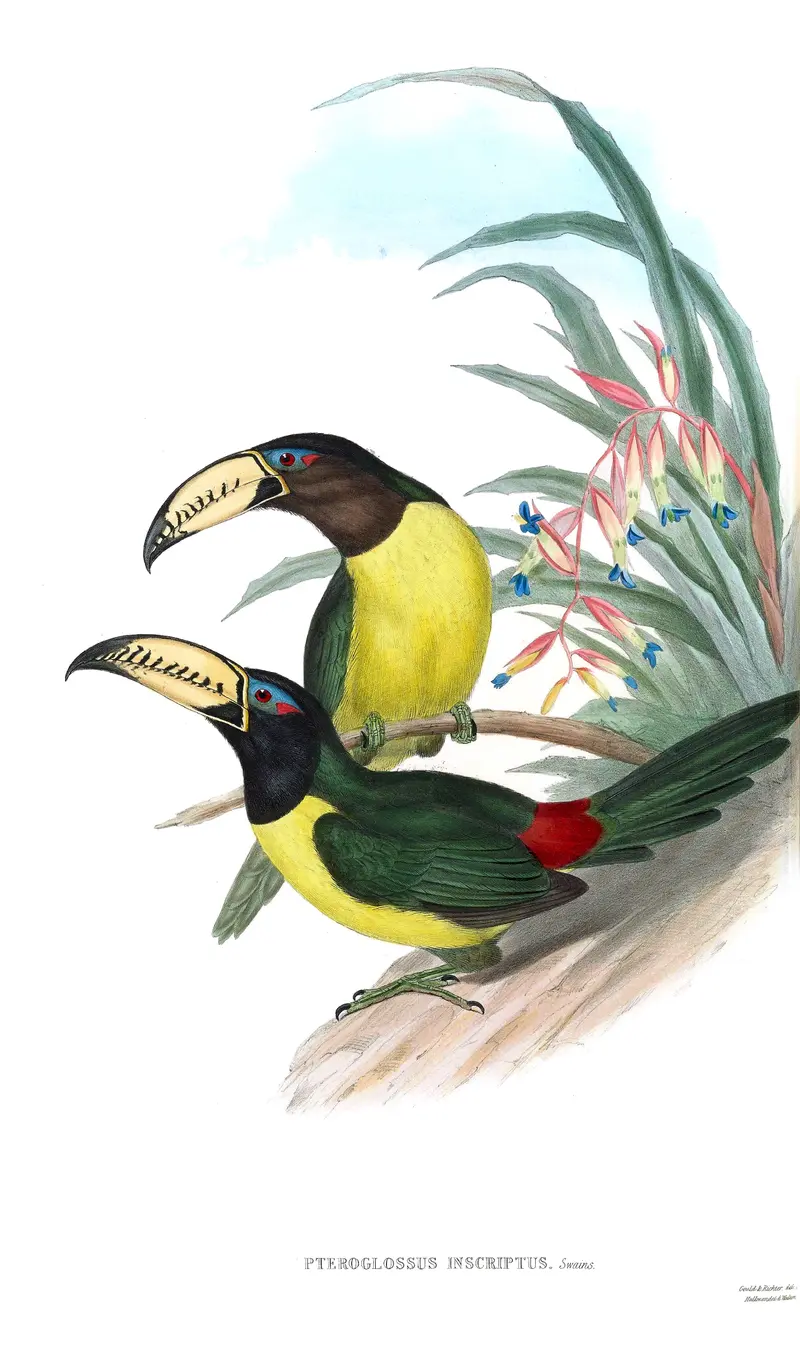
What first catches the eye in Black-billed Mountain Toucan is the bird’s impossible palette—deep turquoise, ochre, crimson, and a flash of violet—rendered with such precision that the feathers seem to shimmer against the pale ground. The toucan leans forward, its beak clasping a nut or insect, poised in a moment of action rather than stillness. The artist draws us in close, the foreground bird dominating the frame, while a second toucan perches behind, echoing the first’s form and suggesting a hidden life within the branches.
Every detail, from the fine scaling of the feet to the subtle gradations of shadow beneath the wing, is chosen to hold our attention, guiding the gaze from the sharp black bill to the riot of color along the plumage. Created around 1870 as a watercolored lithograph, this work belongs to a world where art and science were partners in discovery. Such images were the lifeblood of 19th-century natural history, commissioned by collectors, explorers, and publishers eager to capture the marvels of distant continents. John Gould, famed for his ornithological volumes, helped define the visual language of scientific illustration: accuracy was paramount, but so was drama, ensuring the bird’s character emerged as vividly as its anatomy.
Though little is recorded about this specific sheet, now in a rare maps collection, it stands as a testament to an era when the boundaries of the known world were expanding—and artists like Gould made the exotic immediate, inviting us to look again and see the extraordinary in the details.