Blue-mantled Thornbill — History & Facts
The eye is drawn first to the luminous blue mantles of the hummingbirds, perched in stillness as if caught between one heartbeat and the next. Their delicate forms are rendered with a precision that invites close inspection, each feather catching the light in a way that hints at iridescence. Below them, a cluster of pale violet flowers anchors the scene, while behind, the drama of a distant volcano—its slopes veiled in smoke and a column of fire—adds a sense of latent power.
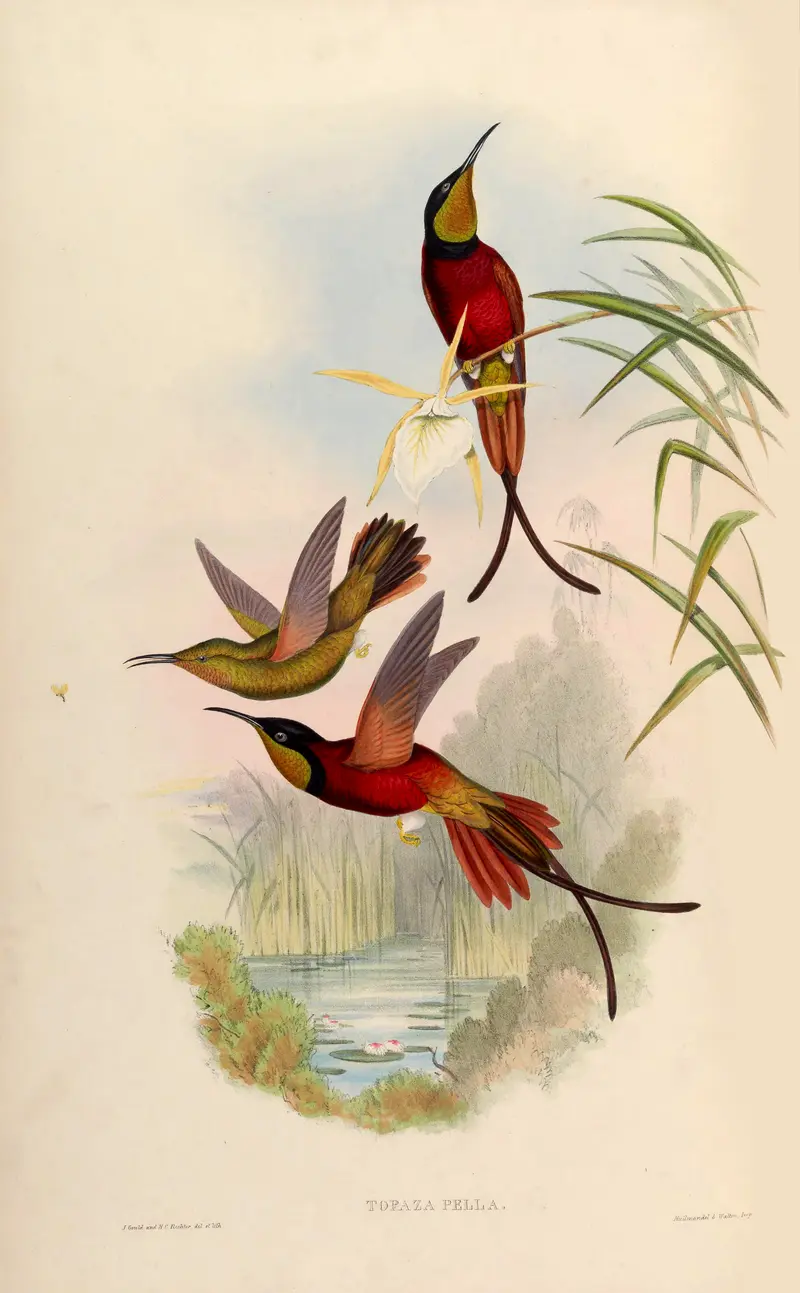
The birds, poised on spiny branches, seem untouched by the looming eruption, their calm a striking contrast to the violence in the background. The composition guides the viewer from the intricate detail of the foreground to the hazy, almost dreamlike mountains beyond, suggesting a world of both fragility and force. Created in 1861 by John Gould for his monumental study of hummingbirds, this image belongs to a tradition of natural history illustration that flourished in the nineteenth century. Such works were often commissioned by scientists, collectors, and wealthy patrons eager to document the wonders of the natural world at a time when exploration and classification were reshaping knowledge.
Gould’s A monograph of the Trochilidae sought not just to record species, but to bring them to life for a European audience hungry for glimpses of the exotic. The careful balance of scientific accuracy and artistic flourish in this plate speaks to that era’s blend of curiosity and wonder—a reminder, as you look again, that every feather and petal was once a discovery.