Breaking hemp — History & Facts
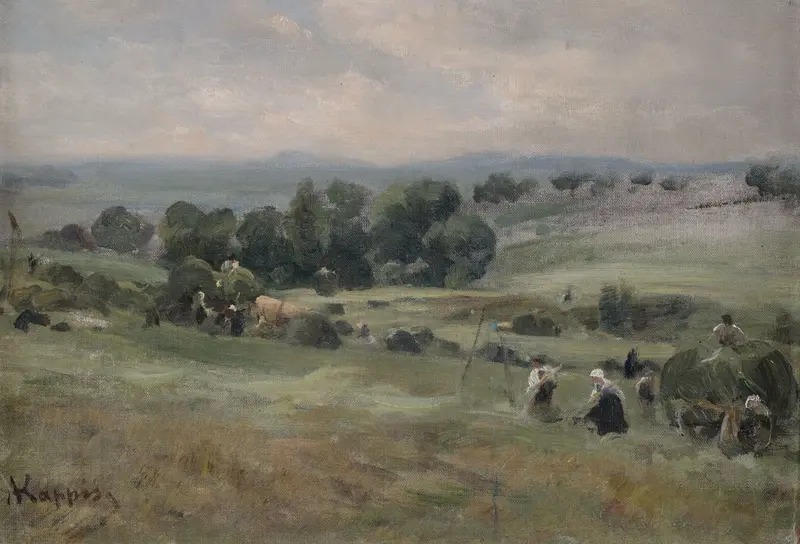
A haze of smoke and golden light draws the eye into the heart of rural labor, where every figure is absorbed in the slow choreography of breaking hemp. The painter, Albert Kappis, guides us through a sunlit clearing alive with movement and purpose: women seated in a loose semicircle, their hands busy at wooden devices, while children and elders cluster nearby, each absorbed in their own small tasks. The smoke rising from the left blurs the boundary between earth and sky, lending the scene a sense of communal ritual, as if the entire village has gathered for this annual rite.
The palette is warm and earthy, with ochres and greens setting a mood of quiet industry, and the dappled sunlight filtering through the trees leads the gaze from one group to the next, never letting the viewer rest too long in one place. Works like this, painted in 1873, belong to a moment when artists across Europe turned their attention to the rhythms of rural life, recording the customs and labors that shaped the countryside before industrial change swept them away. In southern Germany, where Kappis was active, such scenes were both a celebration of local tradition and a subtle assertion of regional identity. These paintings were often commissioned by urban collectors nostalgic for a vanishing way of life, or by civic patrons eager to document agricultural practices.
While little is recorded about the specific journey of this canvas—now known from its appearance at Kunstauktionshaus Schloss Ahlden in 2026—it stands as a vivid window onto a world where work, community, and landscape were woven tightly together. The next time you look, notice how each figure’s gesture fits into the larger pattern, and imagine the rhythm of hands and voices that once filled this field.