
Bullock cart on the road — History & Facts
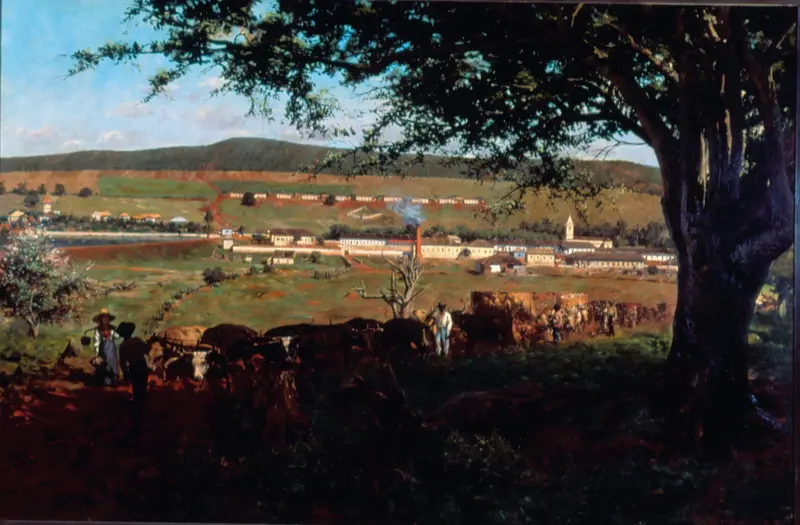
What first draws the eye in Bullock cart on the road is the slow, deliberate procession of cattle, their sturdy forms leading the viewer along a sunlit path that curves into the green embrace of distant hills. The painter’s choice to set the animals in motion, with a lone figure guiding them, turns a rural routine into a quiet procession. The earthy reds of the road and the mottled hides of the oxen are set off by the cool, receding greens and blues of the landscape, inviting the viewer to follow the caravan into the depth of the countryside.
The light here is gentle, diffused, casting soft shadows and lending the scene a sense of calm persistence—work that is both ordinary and enduring. Painted by Antonio Ferrigno between the last years of the nineteenth century and the first of the twentieth, this small oil study belongs to a world on the cusp of change. Such images of agricultural labor were common in Brazil at the time, when artists and patrons alike sought to capture the rhythms of rural life—often for private collections, as with this work, now held in the Projeto del Rei Collection. The painting is thought to be a study for a larger composition, a fragment of the artist’s ongoing fascination with the countryside and its people.
History has kept few traces of the journey this canvas has taken, but its quiet attention to the everyday invites us to linger, tracing the path of the cart as it disappears into memory.
More Artworks by Antonio Ferrigno
More Landscape Art

The Starry Night
Vincent van Gogh

View of Delft
Johannes Vermeer

Water Lilies
Claude Monet

The Grand Canal, Venice, looking north-west from the Ca' Corner to the Ca' Contarini degli Scrigni, with the campanile of Santa Maria della Carità
Canaletto

Windsor Castle
Canaletto

The Grand Canal looking North-East from the Palazzo Dolfin-Manin to the Rialto Bridge
Canaletto