
O Terreiro — History & Facts
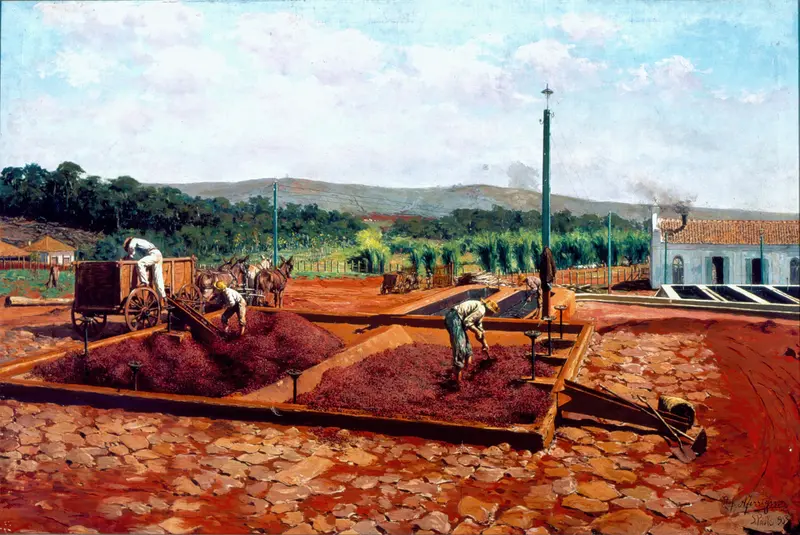
What first grips the viewer in O Terreiro is the sheer choreography of labor: every figure is caught mid-motion, raking, lifting, or carrying, their bodies angled in a dance of repetitive effort beneath a vast, pale sky. The eye is drawn from the foreground—where workers bend low over heaps of pale yellow material—toward the distant, red-roofed buildings and the faint smoke rising from a chimney. The repeated arc of baskets and the rhythm of rakes cutting through the ground create a sense of communal industry, while the long shadows and the haze of dust in the air hint at the relentless sun and the passage of time.
The palette, dominated by ochres and muted blues, sets a mood of dusty heat and quiet endurance, making the viewer feel the weight of the day. Painted in 1903, this work belongs to a period when Brazilian artists such as Antonio Ferrigno turned their attention to the realities of rural and plantation life, often at the request of landowners or institutions eager to record the nation’s agricultural wealth. The setting—a coffee drying yard, or terreiro—was central to Brazil’s booming coffee economy, and images like this served both as documentation and as subtle argument for progress and productivity. Now held in the Museu Paulista da USP, O Terreiro stands as a vivid window onto a world in transition, caught between tradition and modernization.
The painting invites us to look closer, not just at the scene but at the lives and histories woven into each gesture and shadow.
More Artworks by Antonio Ferrigno
More Genre Scene Art

Banquet of the Officers of the St George Civic Guard
Frans Hals

Rembrandt and Saskia in the Scene of the Prodigal Son
Rembrandt van Rijn

Bal du moulin de la Galette
Pierre-Auguste Renoir

Quadrille at the Moulin Rouge
Henri de Toulouse-Lautrec

A Burial at Ornans
Gustave Courbet

When Will You Marry?
Paul Gauguin