
A colheita — History & Facts
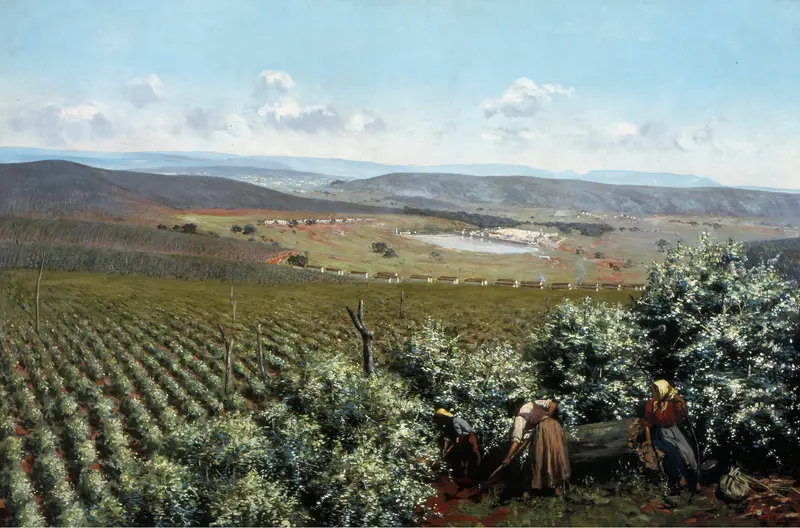
What first catches the eye in A colheita is the sheer density of life and labor, woven through a thicket of green under a broad, pale sky. The painter draws us into the heart of a harvest, where figures—women, men, and even children—are scattered among the coffee bushes, each absorbed in their task. Sunlight filters through the foliage, picking out the red berries and the bright kerchiefs, guiding the viewer’s gaze from the shaded foreground to the distant hills.
The central woman, basket in hand, pauses mid-step, her gaze meeting ours as if to invite us into the rhythm of the day. Every gesture, from the child crouched near a sack to the worker on the ladder, is a note in the symphony of collective effort, while the earthy palette roots the scene in the rich soil underfoot. Painted in 1903, this work belongs to a period when Brazilian artists, often under the influence of European academic traditions, turned their attention to the realities of rural labor and the landscapes that shaped the nation’s identity. Antonio Ferrigno was known for his detailed depictions of coffee plantations, a subject central to Brazil’s economic and social history at the turn of the twentieth century.
While history has left few traces of this particular canvas’s journey, we know it now forms part of the Museu Paulista da USP’s collection, a fitting home for a painting so deeply tied to the land and its people. Look again at the horizon: the distant town, the suggestion of industry, and the sweep of hills remind us that every harvest scene is also a story about change—about the world growing beyond the frame.
More Artworks by Antonio Ferrigno
More Genre Scene Art

Banquet of the Officers of the St George Civic Guard
Frans Hals

Rembrandt and Saskia in the Scene of the Prodigal Son
Rembrandt van Rijn

Bal du moulin de la Galette
Pierre-Auguste Renoir

Quadrille at the Moulin Rouge
Henri de Toulouse-Lautrec

A Burial at Ornans
Gustave Courbet

When Will You Marry?
Paul Gauguin