
O Beneficiamento — History & Facts
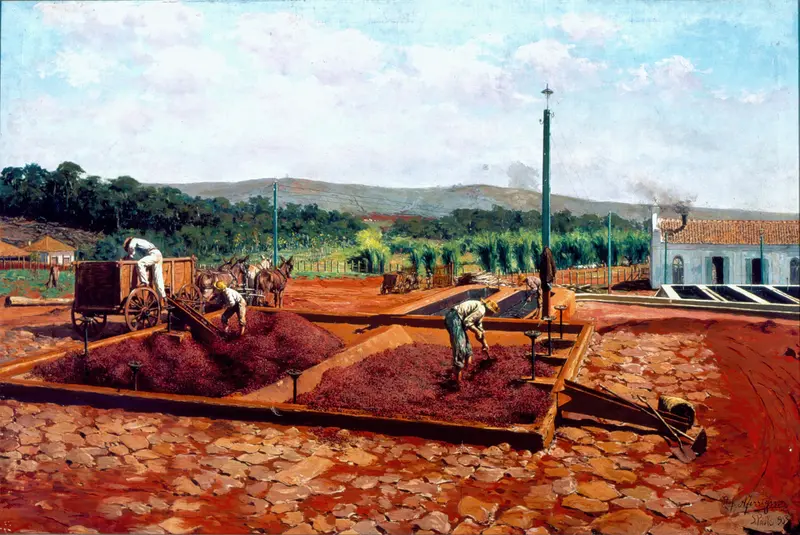
A shaft of sunlight pours across the busy heart of a coffee plantation, illuminating not just the labor but the rhythm of rural life at the turn of the twentieth century. The eye is drawn first to the figures bent in concentration, their hands sorting and tending to the coffee beans that spill across the ground in neat, golden rows. Every gesture is purposeful: a woman’s headscarf shields her from the glare, a man’s rolled sleeves speak of hours spent in steady work.
The palette, all ochres and russets, is warm but unsentimental, emphasizing both the bounty of the harvest and the relentless heat of the day. In the distance, the outlines of machinery and drying racks hint at the scale and modernity of this agricultural world, while the figures themselves anchor the scene in lived experience. Painted in 1903, this work belongs to a moment when Brazil’s coffee economy was booming, drawing waves of immigrant labor and transforming the landscape around São Paulo. Paintings like this, now preserved in the Museu Paulista da USP, were often intended to document and dignify the new realities of labor and progress, serving both as records and as celebrations of the nation’s agricultural might.
Few details survive about the commission or early history of this particular canvas, but its presence in the museum’s collection speaks to an era when art and industry were closely entwined. The viewer is left to wonder about the lives behind these faces, and to trace the journey of coffee from these sunlit yards to distant cups.
More Artworks by Antonio Ferrigno
More Genre Scene Art

Banquet of the Officers of the St George Civic Guard
Frans Hals

Rembrandt and Saskia in the Scene of the Prodigal Son
Rembrandt van Rijn

Bal du moulin de la Galette
Pierre-Auguste Renoir

Quadrille at the Moulin Rouge
Henri de Toulouse-Lautrec

A Burial at Ornans
Gustave Courbet

When Will You Marry?
Paul Gauguin