
O Lavadouro — History & Facts
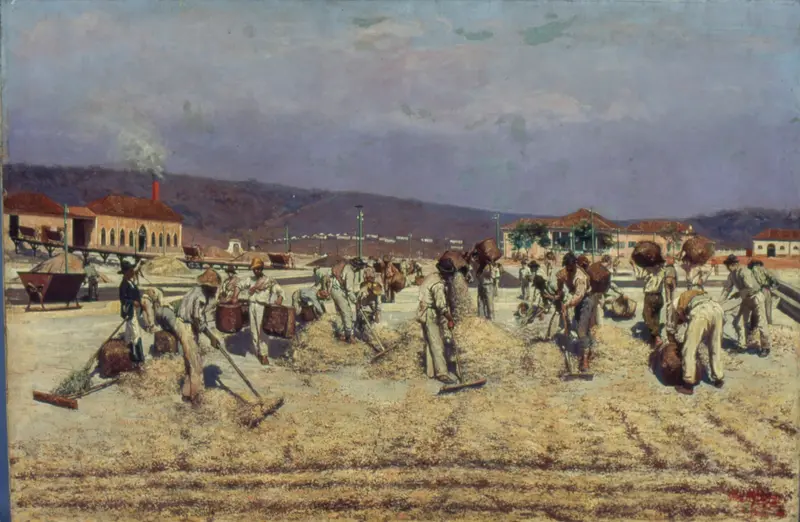
What first catches the eye in O Lavadouro is the sheer choreography of labor, set against the vast, sunlit expanse of rural Brazil. The workers, bent to their tasks, are not isolated figures but part of a larger, almost rhythmic process: the turning, sifting, and washing of what appears to be coffee beans, their deep red hues echoing the rich earth underfoot. The light is sharp and clear, casting crisp shadows that guide the gaze from the foreground—where the labor is most intense—toward the distant hills and the whitewashed building, its chimney trailing a thin plume of smoke.
The artist draws the viewer into the heart of the action, making the physicality of the work palpable: the straining backs, the careful balance on the cart, the steady hands at the sluice. Painted in 1903, this scene belongs to a moment when Brazil’s coffee economy was booming, and images like this served both as documentation and as celebration of agricultural modernity. Works of this kind were often commissioned or collected by landowners and institutions eager to showcase progress and productivity, and O Lavadouro now forms part of the Museu Paulista da USP’s collection. While history has kept few traces of the individual lives depicted here, the painting stands as a vivid record of a world in transition—where manual labor, industrial ambition, and the rhythms of rural life converged under the Brazilian sun.
The longer you look, the more the details—tools, textures, gestures—invite you to imagine the sounds and stories of that day.
More Artworks by Antonio Ferrigno
More Genre Scene Art

Banquet of the Officers of the St George Civic Guard
Frans Hals

Rembrandt and Saskia in the Scene of the Prodigal Son
Rembrandt van Rijn

Bal du moulin de la Galette
Pierre-Auguste Renoir

Quadrille at the Moulin Rouge
Henri de Toulouse-Lautrec

A Burial at Ornans
Gustave Courbet

When Will You Marry?
Paul Gauguin