
Bunte Landschaft — History & Facts
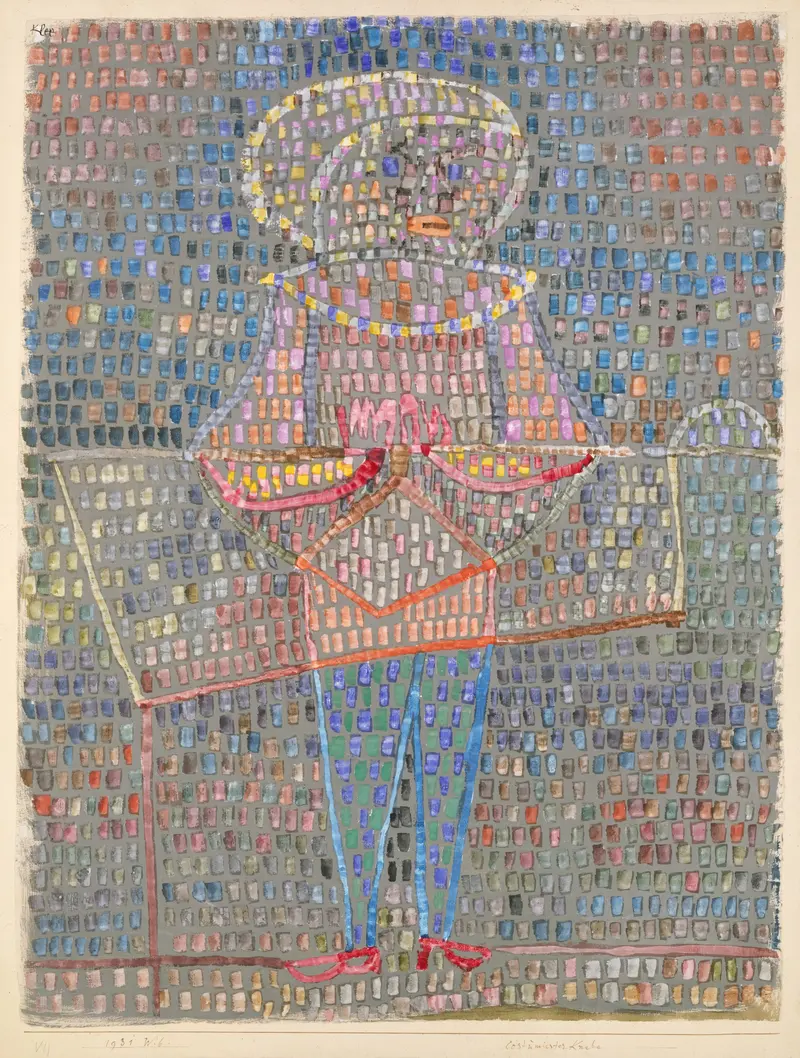
In Bunte Landschaft, vibrant colors dominate the canvas, creating a lively and abstract representation of a landscape. The painting features swirling forms and geometric shapes that suggest hills, trees, and skies. Klee uses a palette of reds, blues, and yellows, which interact to create a sense of movement and rhythm.
The overall effect is playful and imaginative, inviting viewers to explore the scene further. The painting is characterized by its use of bold colors and simplified forms, typical of Paul Klee's style. Klee often employed a technique that blends abstraction with representation, allowing for a unique interpretation of landscapes. The brushwork is expressive, contributing to the dynamic quality of the piece.
Viewers can see how Klee's innovative approach to color and form sets this work apart from traditional landscape paintings. Paul Klee, a Swiss painter associated with Expressionism, created Bunte Landschaft during a period of exploration in his artistic style. This work reflects Klee's fascination with color theory and abstraction, which he often combined with elements of fantasy. An interesting fact about this painting is that it exemplifies Klee's belief that art should express the inner emotions of the artist rather than just depict the external world.
This approach makes Bunte Landschaft a significant piece in Klee's oeuvre.
More Artworks by Paul Klee

More Landscape Art

The Starry Night
Vincent van Gogh

View of Delft
Johannes Vermeer

Water Lilies
Claude Monet

The Grand Canal, Venice, looking north-west from the Ca' Corner to the Ca' Contarini degli Scrigni, with the campanile of Santa Maria della Carità
Canaletto

Windsor Castle
Canaletto

The Grand Canal looking North-East from the Palazzo Dolfin-Manin to the Rialto Bridge
Canaletto