Damen med den vita sjalen — History & Facts
No other portrait by Nils Dardel has sparked as much speculation as Damen med den vita sjalen. The sitter’s identity remains a mystery, fueling decades of debate among art historians and collectors. Some have suggested she was a muse from Dardel’s Parisian circle, while others point to a possible connection with the Swedish aristocracy.
The work’s elusive provenance and lack of date only add to its intrigue, making it a touchstone for those fascinated by the secrets behind the canvas. The painting captures a woman at a moment of poised introspection, her pale scarf draped elegantly over her shoulders, drawing the viewer’s eye to the delicate curve of her neck. Her gaze is turned away, lost in thought, while a subtle tension animates her hands—one gently clutching the edge of the shawl, the other resting in her lap. The cool, clear light accentuates the contrast between her soft features and the crisp whiteness of the fabric, a motif Dardel often used to signal both vulnerability and quiet strength.
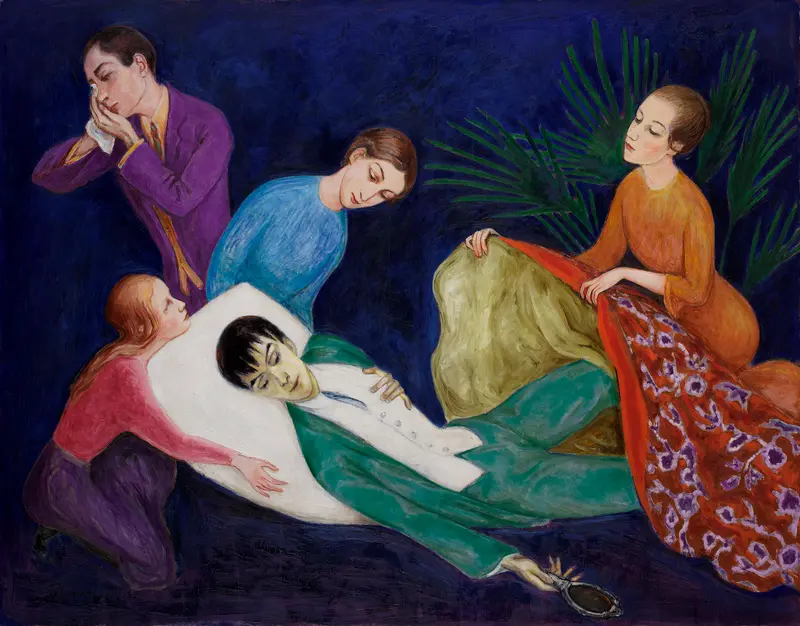
Unlike the flamboyant theatricality of Dardel’s The Dying Dandy, here he opts for restraint, inviting comparison to the psychological depth of Anders Zorn’s portraits, though with a more stylized, modern touch. Little is known about the early life of Damen med den vita sjalen as an object. Its date and original owner are unrecorded, and it does not appear in early exhibition catalogues of Dardel’s work. The painting surfaced in the mid-20th century in a private Swedish collection, where it remained largely unseen by the public until recent years.
Today, it stands as a testament to Dardel’s ability to blend intimacy with enigma, and occupies a special place among his portraits for its understated atmosphere and the enduring questions it poses.