Diana and Man ? — History & Facts
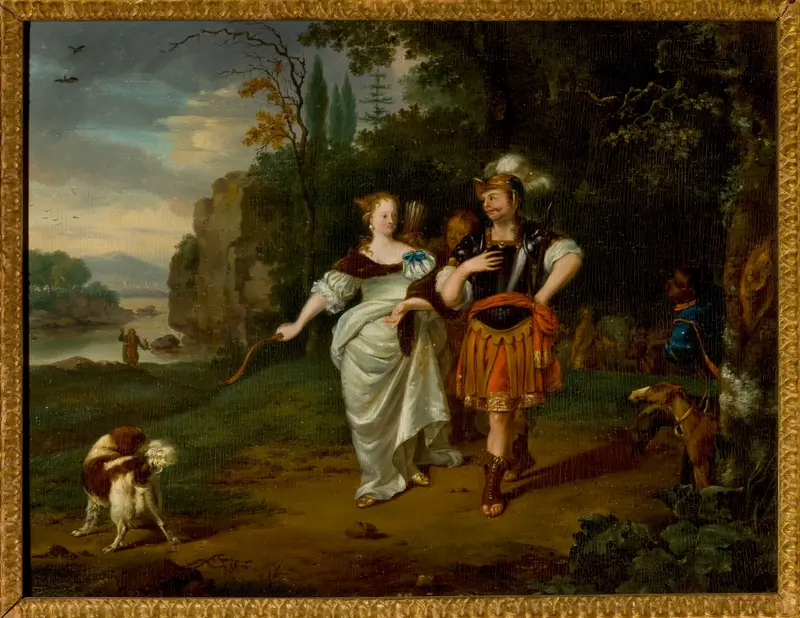
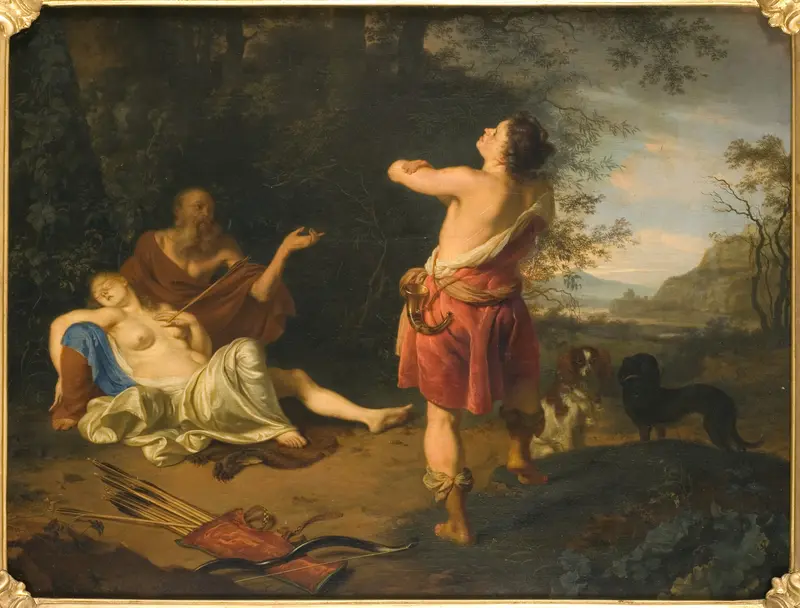
What first catches the eye in Diana and Man ? is the theatrical encounter at its heart: a woman in gleaming white, crowned with a crescent moon, strides forward with a bow in hand, her gaze fixed on a man clad in fanciful armor and a plumed helmet. The two seem locked in a moment of conversation or challenge, her posture confident, his expression almost amused, a hand pressed to his chest as if in self-assurance or surprise. Around them, the world is alive with narrative cues: a dog at her side, another lurking in the shadows, and a richly dressed attendant peering from behind a tree.
The light falls most generously on the central figures, heightening the sense of drama and drawing us into their private exchange, while the landscape behind recedes into misty distance, hinting at a world beyond this charged meeting. Painted in 1657, this work by Ary de Vois belongs to a period when Dutch artists delighted in mythological subjects, often blending classical themes with contemporary costume and lively psychological interplay. Scenes like this, featuring gods and mortals in wooded landscapes, were sought after by collectors eager to display both their taste and learning. The precise moment chosen here—poised between confrontation and flirtation—invites speculation about the story: is this Diana, goddess of the hunt, encountering a trespasser, or a more ambiguous meeting? The painting’s blend of polished surfaces, intricate fabrics, and sly glances is typical of the mid-seventeenth century’s fascination with wit and ambiguity.
History has kept few traces of this particular painting’s journey, but its spirited figures and lush setting invite us to linger, piecing together their secrets from every detail.