Forest Road — History & Facts
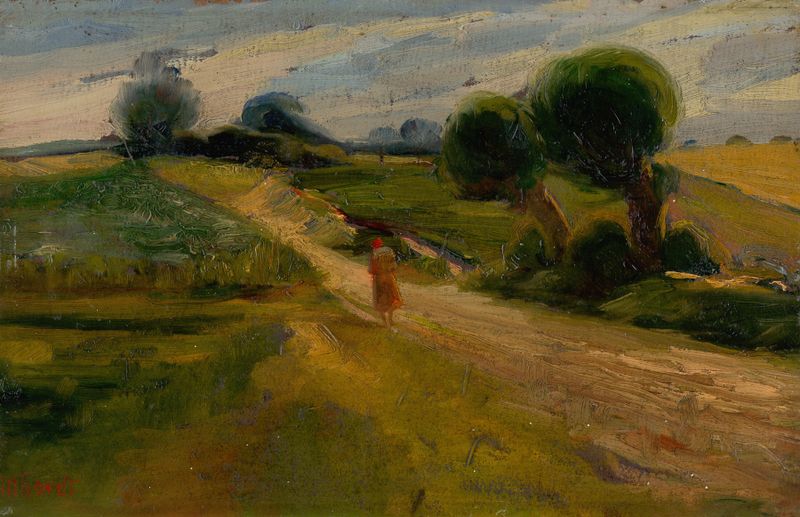
In a world that rushes forward, the act of capturing a moment becomes a rebellion against the tide of fleeting time, a celebration of ecstasy that defies erasure. Look to the foreground, where a winding path unfurls like a ribbon, inviting you into the depths of the forest. The rich greens of the foliage contrast beautifully with the warm earth tones of the road, creating a harmonious balance that draws the eye deeper into the scene. Notice the interplay of light filtering through the canopy above, casting dappled shadows that dance across the path.
Each subtle brushstroke reveals a meticulous attention to detail, a reflection of the artist's reverence for nature's beauty and complexity. Beneath the serene surface lies a contrast between stillness and movement. The vibrant hues evoke a sense of life and vitality, suggesting that the forest is brimming with hidden stories waiting to be unearthed. The road, while seemingly tranquil, symbolizes a journey—both physical and emotional—implying that every step taken holds the promise of discovery and transformation.
This duality creates an emotional tension, inviting the viewer to consider their own path amid the whispers of the trees. In 1900, during a period of burgeoning artistic expression, Pitthordt crafted this piece as he sought to capture the essence of the natural world. Living in a time when realism and impressionism were colliding, he felt the urge to depict nature not just as it was, but as it could be felt—alive with essence and memory. This work reflects both his personal journey and the broader exploration of humanity's connection to the environment during an era of rapid change.