Green Aracari — History & Facts
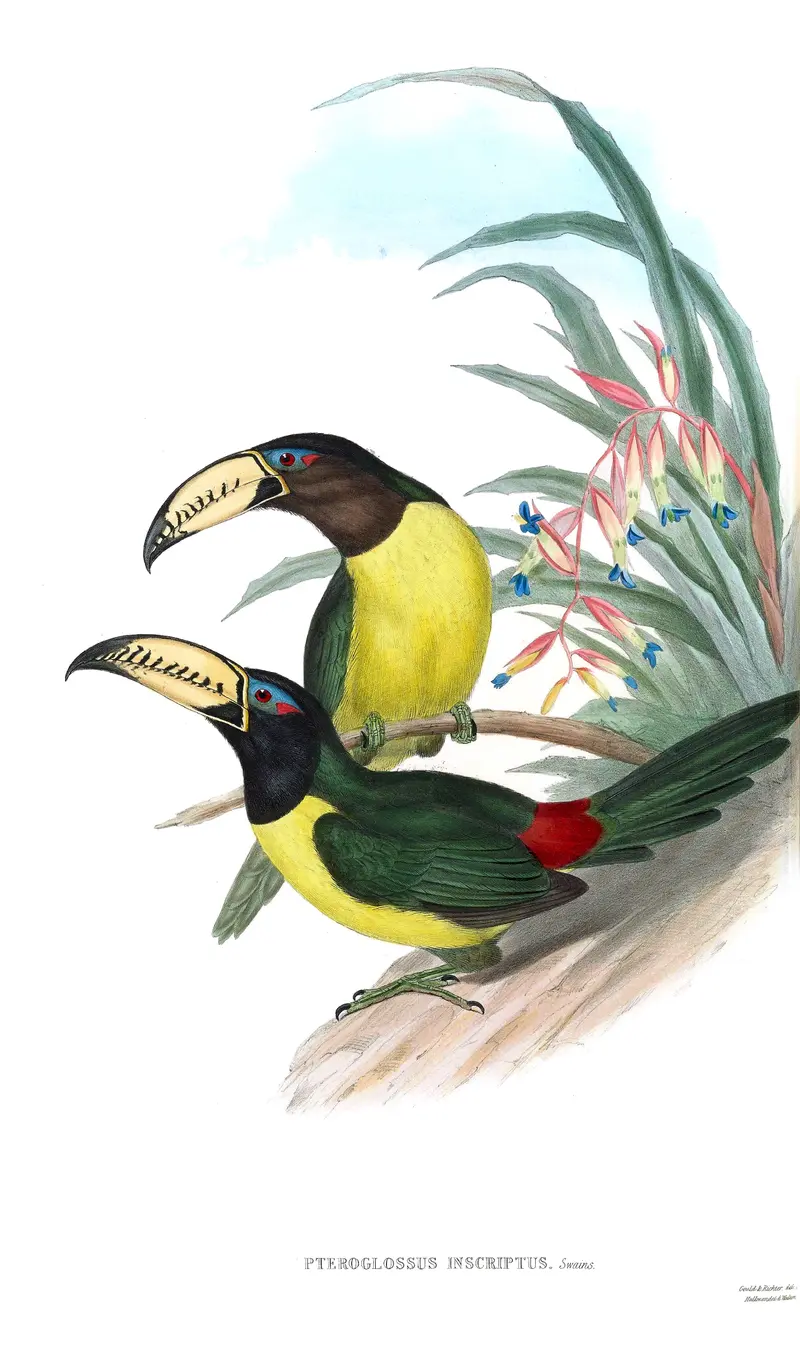
What first catches the eye in Green Aracari is the almost theatrical pairing of two birds, their beaks aglow with sunset colors, poised in perfect parallel on a branch. The artist draws us in with a play of contrasts: the luminous yellow breasts, the sharp black and green plumage, and the vivid red patch at the tail, all set against a mist of delicate tropical foliage. The birds’ eyes, rimmed with a startling blue, seem to pulse with alertness, as if aware of being observed.
Every feather is rendered with a precision that suggests both scientific curiosity and a painter’s delight in color. The careful placement of the birds—nestled together, yet each distinct—invites the viewer to linger over the subtle differences in their markings and posture. This work belongs to the golden age of natural history illustration, when explorers and artists collaborated to bring the wonders of distant continents to European audiences. Created in 1854 for A Monograph of the Ramphastidæ, Or Family of Toucans, this plate by John Gould was part of a larger effort to catalogue and celebrate the diversity of tropical birdlife.
Such illustrations were not mere decoration; they were tools of science, commissioned by collectors, naturalists, and learned societies eager to possess the world in images. History has kept few traces of the individual journeys of these plates, but their purpose is clear: to astonish, to educate, and to spark the desire to see more. The longer you look, the more the birds’ world seems to open up before you.