Grey-breasted Sabrewing — History & Facts
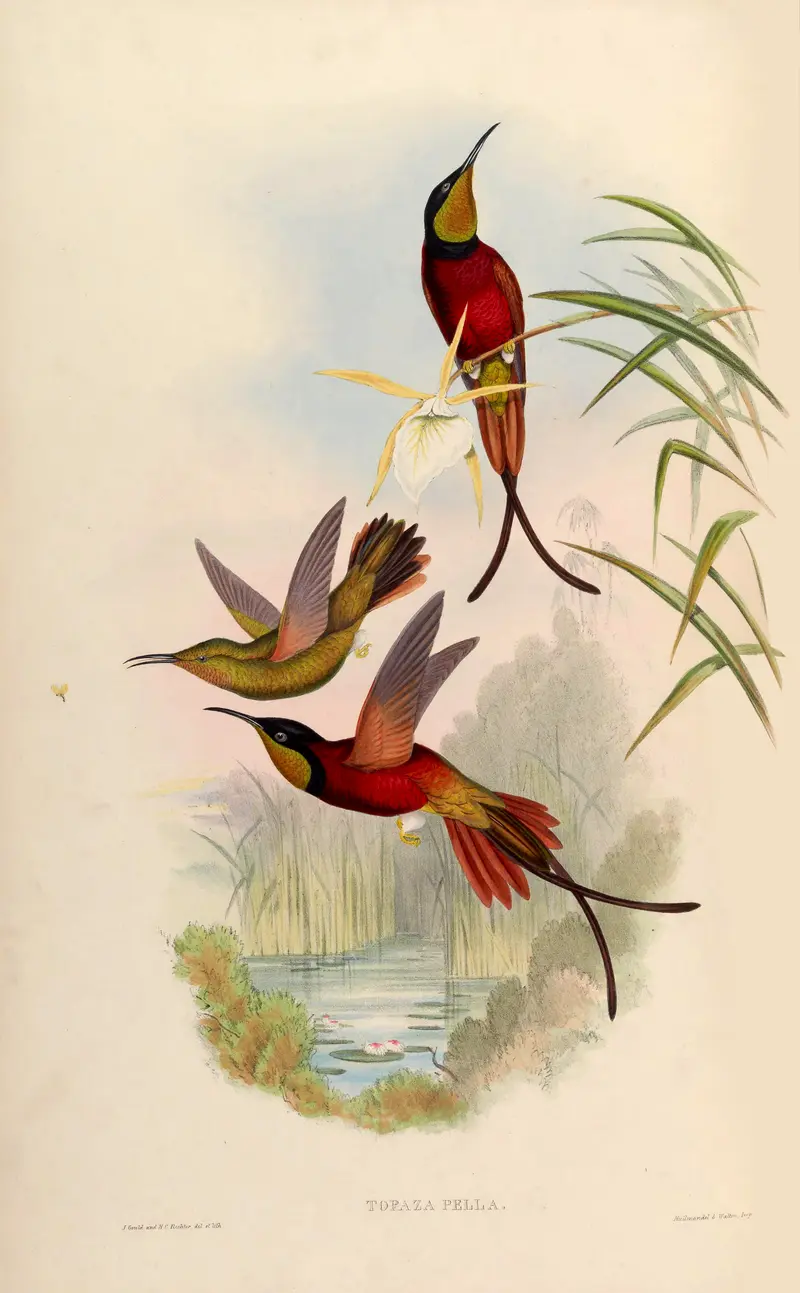
The eye is drawn first to the electric shimmer of green on the wings and crown, a flash of life suspended against the pale wash of the sky. One Grey-breasted Sabrewing hovers, wings blurred in motion, its long beak poised at the heart of an orchid—while its companion perches above, alert, watching. The careful placement of the birds and flowers turns the page into a stage: the sweep of the lower leaf anchors the composition, while the curling stems guide the gaze upward and back, echoing the birds’ dance.
Light falls softly, lending the scene a sense of stillness just before movement resumes, and the delicate pinks and whites of the orchids set off the hummingbirds’ subtle iridescence. This work belongs to the golden age of natural history illustration, when explorers and artists joined forces to catalogue the wonders of the world for European audiences hungry for novelty and knowledge. Created in 1861 for A monograph of the Trochilidae, or family of humming-birds, John Gould’s image is both scientific record and celebration of beauty, made for collectors and scholars alike. Such illustrations were prized not only for their accuracy but for their ability to conjure the living creature in a world before color photography.
History has kept few traces of the specific journeys behind each plate, but the care in this rendering invites us to linger, imagining the world it was meant to reveal.