Gustaf Hellström, 1882-1953, författare — History & Facts
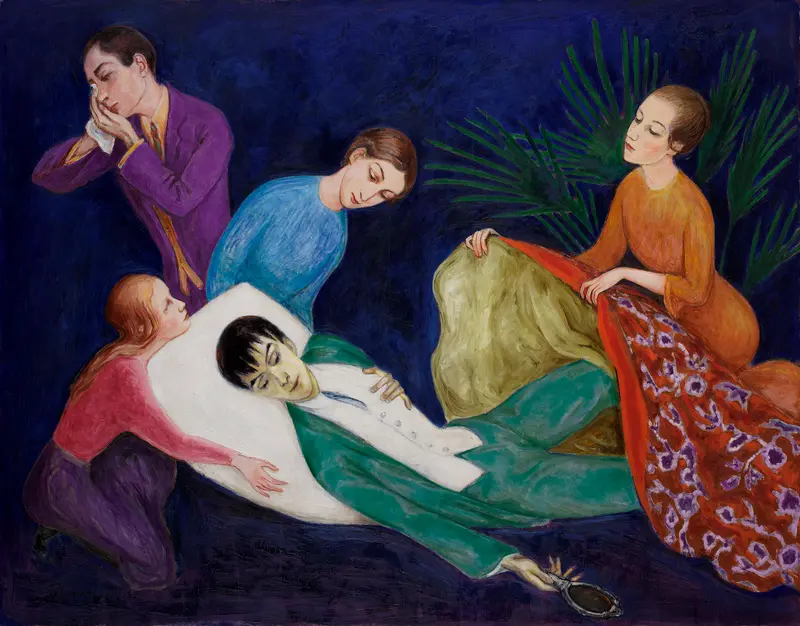
When Nils Dardel painted Gustaf Hellström, 1882-1953, författare, he captured not just the likeness of a celebrated Swedish writer, but also a friendship at the heart of early 20th-century Scandinavian culture. Hellström, a prominent journalist and novelist, was a central figure in Swedish literary circles, and Dardel—known for his vivid, modernist portraits—chose him as a subject at a time when both men were shaping their respective arts. The portrait stands as a testament to the close-knit world of Swedish artists and writers, where creative boundaries were often blurred, and personal relationships fueled new directions in painting and literature. In the image, Hellström is presented with a direct, almost challenging gaze, his posture relaxed yet alert, as if caught mid-thought.
Dardel’s use of bold lines and unexpected color—hallmarks of his style—lend the scene a psychological intensity, drawing the viewer into Hellström’s inner world. The background, likely pared down to focus attention on the sitter, echoes the approach Dardel took in his portrait of Nita Wallenberg, where setting is secondary to character. The careful rendering of Hellström’s features, combined with subtle clues like the open book or pen, signals his vocation and intellectual energy, while the interplay of light and shadow animates the sitter’s face with a sense of immediacy. The exact circumstances of the painting’s commission and early history remain unclear, as is often the case with Dardel’s portraits of his contemporaries.
It is not known whether the work was painted in Hellström’s home, a studio, or as a private commission, nor is the current location of the painting widely documented. What is certain is that Gustaf Hellström, 1882-1953, författare belongs to a period when Nils Dardel was at the height of his career, producing a series of incisive portraits that captured the personalities of Sweden’s cultural elite. Today, the painting endures as a vivid record of a literary life, and a window into the artistic ferment of early 20th-century Sweden.