
Hercules Killing the Stymphalian Birds — History & Facts
The first thing to seize the eye here is not the famous hero, but the tension that crackles from his drawn bow—a moment stretched to its limit. Hercules Killing the Stymphalian Birds by Albrecht Dürer captures a myth balanced on the edge of action, with Hercules’ sinewy frame coiled in the act of release. The hero’s focus is absolute, his gaze locked on the monstrous birds that swoop and twist above a distant, fortified town.
The shield strapped to his arm gleams with intricate patterning, a flash of gold against the earthy landscape, as if to remind us that even legends require protection. The landscape itself, rendered in deep greens and blues, recedes into a misty horizon, lending the scene a sense of both immediacy and mythic distance. Painted in 1500, this work stands at a crossroads of Renaissance innovation and Northern precision. The myth of Hercules and the Stymphalian birds—creatures said to have metallic feathers and deadly beaks—was a favorite among artists of the period, symbolizing the triumph of human ingenuity over chaos.
Here, Dürer chooses to freeze the instant before violence: Hercules’ muscular back, the taut bowstring, and the unnatural forms of the birds all pull the viewer into the suspense. The birds themselves, almost serpentine, are rendered with an eerie, otherworldly quality, their wings and talons more fantastical than naturalistic. The fortified town below suggests a world at risk, its safety dependent on the hero’s aim.
Works like this were often commissioned to decorate palaces or civic buildings, celebrating both classical learning and the virtues of strength and courage. In 1500, artists in the German lands were absorbing Italian ideas about anatomy and perspective, and Dürer was at the forefront of this exchange, marrying the clarity of Northern detail with the grandeur of myth. Though little is recorded about the specific journey of this painting, its survival in the anagoria collection lets us glimpse a moment when myth, art, and ambition converged.
The longer you look, the more the painting invites you to inhabit that charged pause, wondering what will happen when the arrow flies.
More Artworks by Albrecht Dürer

Melancholia
Albrecht Dürer

St. George and the dragon.
Albrecht Dürer
Self-Portrait with Fur-Trimmed Robe
Albrecht Dürer

Wing of a European Roller
Albrecht Dürer

Iris
Albrecht Dürer

The Great Piece of Turf
Albrecht Dürer
Salvator Mundi
Albrecht Dürer
The Adoration of the Magi
Albrecht Dürer
Young Hare
Albrecht Dürer
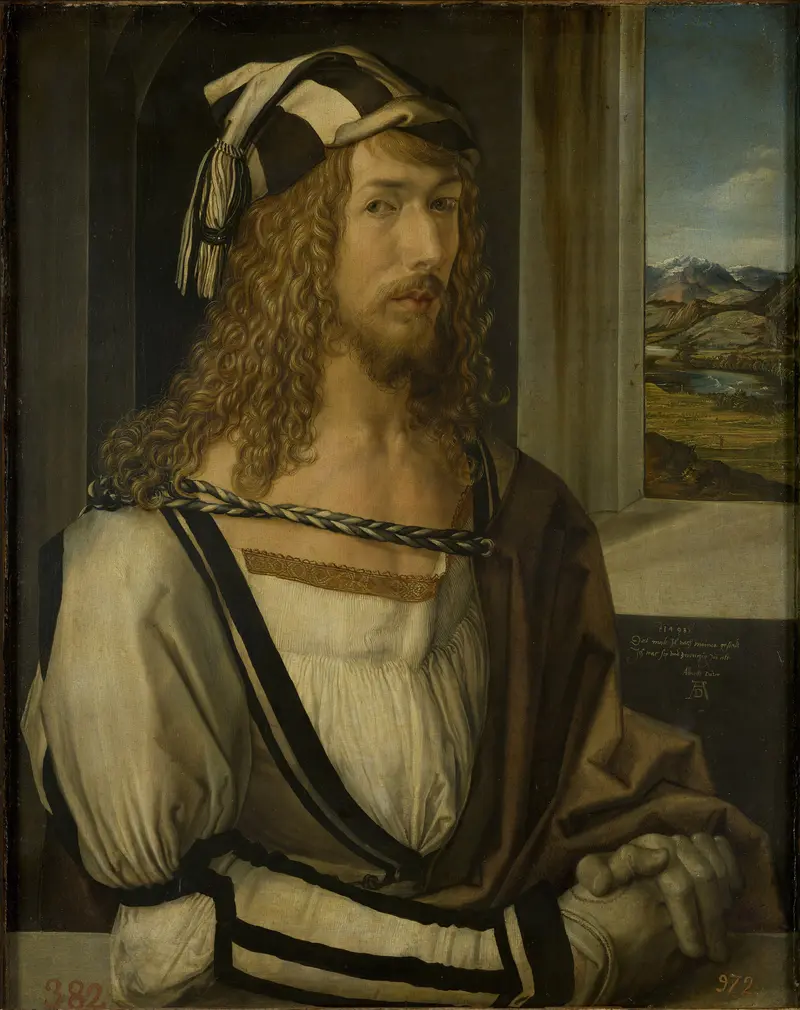
Self-portrait
Albrecht Dürer




