
Immaculate Conception — History & Facts
A luminous figure of the Virgin Mary stands at the center, dressed in a flowing blue mantle over a rose-colored robe, her hands crossed gently over her chest and her gaze turned upward. Above her, a radiant white dove surrounded by golden light hovers at the apex of the composition, encircled by a dense ring of cherubic heads that fill the upper edge of the painting. At the lower edge, an angel with light wings tipped in dark feathers and draped in a vivid yellow garment kneels on a cloud, turning upward toward Mary.
Two cherubs, one with outstretched arms, rest at the Virgin's feet, their forms emerging from swirling clouds and drapery. Light in the scene radiates from the dove, casting a golden glow that illuminates Mary's face and the surrounding angels, while the rest of the painting is enveloped in shadowy blues, greys, and blacks. El Greco shapes the figures with elongated forms and swirling, expressive brushstrokes, giving the entire composition a sense of upward movement and spiritual intensity.
The paint is applied in energetic, visible strokes, especially in the clouds and draperies, where the transitions between color and shadow are abrupt and dramatic. The composition is vertical and symmetrical, with Mary as the focal point, flanked by angels and rising above the earthly realm below. It is now displayed in the Museum of Santa Cruz in Toledo. The style of the painting, with its elongated figures, vibrant color contrasts, and dramatic light, is characteristic of Mannerism, the movement with which El Greco is associated.
Sources: Wikidata Q5392381 · Wikipedia: The Immaculate Conception (El Greco, Toledo) · Image source (Wikimedia Commons)
More Artworks by El Greco
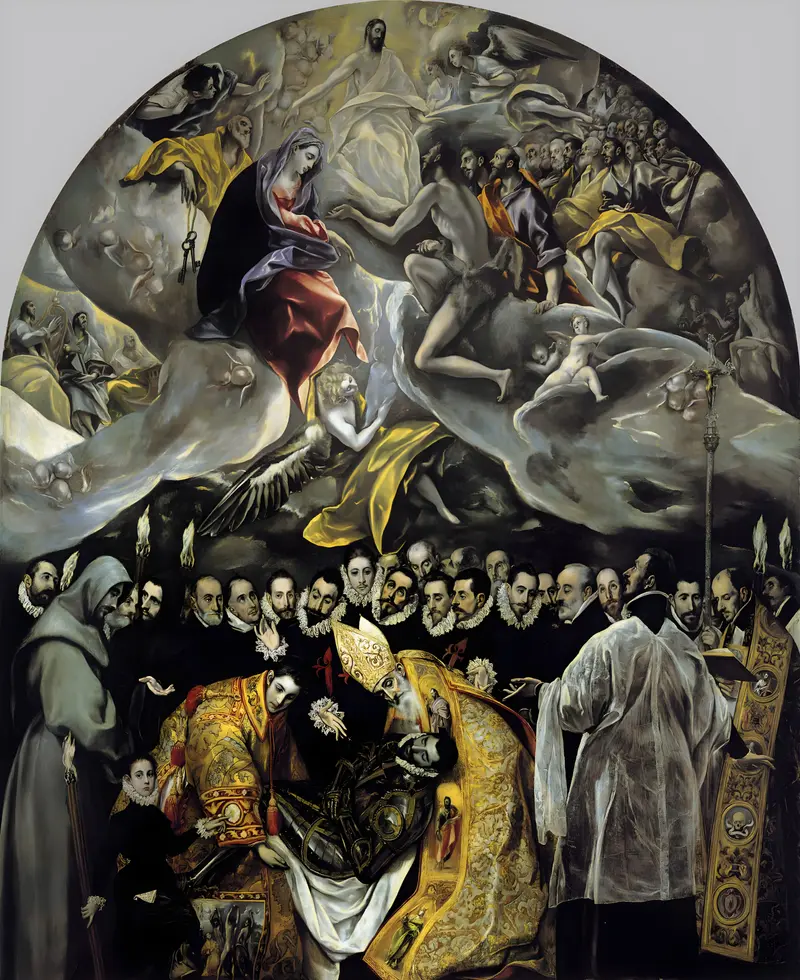
The Burial of the Count of Orgaz
El Greco

Portrait of an Apostle (Saint Philip)
El Greco

Saint Luke the Evangelist
El Greco

The Immaculate Conception
El Greco

The Feast in the House of Simon
El Greco

View of Toledo
El Greco

Saint Ildefonso
El Greco

The Disrobing of Christ
El Greco

The Vision of Saint John
El Greco

The Marriage of the Virgin
El Greco





