
Landscape with a Windmill — History & Facts
Who listens when art speaks of silence? In the stillness of a tranquil landscape, a windmill stands sentinel, its blades frozen in time, cradling the weight of an unspoken loss. Look to the horizon, where the gentle sweep of soft greens meets a muted sky. Notice how the windmill, positioned slightly off-center, draws your gaze with its intricate details and weathered texture. The painter captures the subtle play of light, as it filters through the clouds, casting a silvery sheen over the fields below.
Each brushstroke seems to whisper the essence of an expansive landscape, yet the absence of movement creates an unsettling stillness that lingers in the air. Within this pastoral scene, contrasts emerge between the vibrancy of nature and the solemnity of the windmill. The vibrant greens speak of life and vitality, yet the solitary structure evokes a sense of isolation and grief. Shadows stretch long across the canvas, as if mourning the passage of time, imbuing the landscape with a melancholic beauty that suggests an unfulfilled longing.
It is a tender reminder of what is lost and the fragility of existence. In the 19th century, Jongkind painted this work during a period of transition in his artistic journey. Living in France, he was influenced by the burgeoning Impressionist movement, which sought to capture fleeting moments in nature. During this time, he grappled with both personal and professional challenges, seeking to establish his voice within a rapidly evolving art world.
Landscape with a Windmill encapsulates Jongkind's mastery in blending emotion with the natural world, a poignant reflection of his life's complexities.
More Artworks by Johan Barthold Jongkind
Browse all →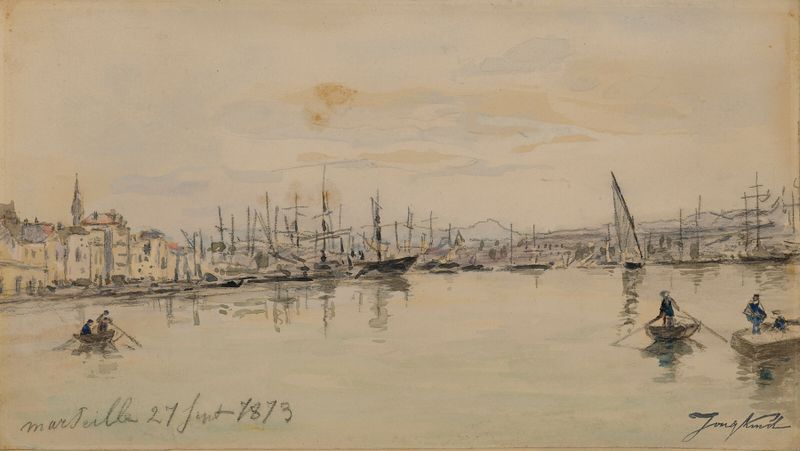
Le Port de Marseille
Johan Barthold Jongkind

Canal Saint-Martin
Johan Barthold Jongkind

Countryside near Brezins, between Grenoble and Vienne
Johan Barthold Jongkind

Notre-Dame vue du quai de la Tournelle
Johan Barthold Jongkind

Environs de Grenoble
Johan Barthold Jongkind

Clair de lune à Overschie (environs de Rotterdam)
Johan Barthold Jongkind

Port de Honfleur
Johan Barthold Jongkind
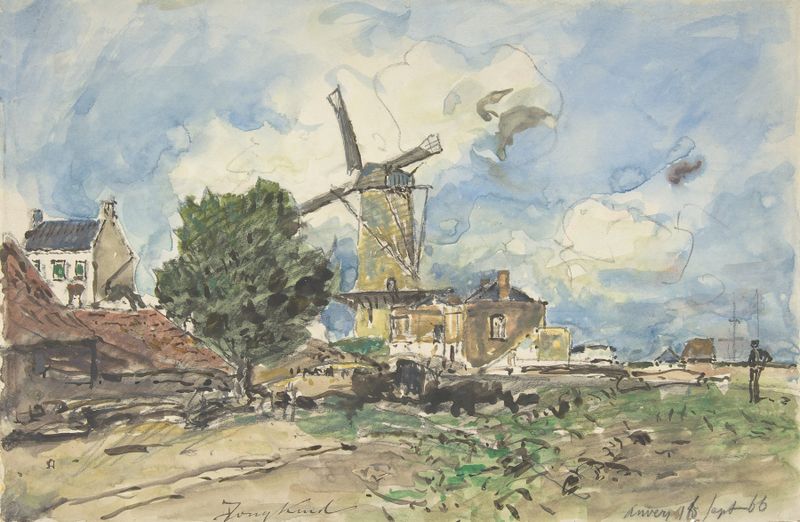
Wind Mill at Antwerp
Johan Barthold Jongkind

Le Havre
Johan Barthold Jongkind

The Church of Overschie
Johan Barthold Jongkind





