
Nativity — History & Facts
In 1597, El Greco received a commission that would become one of his most enigmatic treatments of the Nativity: a painting for the Colegio de Doña María de Aragón in Madrid. This work was part of a grand altarpiece ensemble, now dispersed, and it stands out because several versions of the Nativity by El Greco survive, but each is markedly different in composition and mood. Scholars have long debated the original arrangement of these panels, and the whereabouts of some remain unknown, adding a layer of mystery to the painting’s history.
The Madrid Nativity is especially prized for the way it fuses Venetian color with the elongated forms that became El Greco’s signature. At the heart of the scene, the newborn Christ radiates light, illuminating the faces of Mary and the shepherds who kneel in awe. El Greco captures the moment just after the birth, when heaven and earth seem to meet in a burst of supernatural brilliance. The swirling, elongated figures—Mary’s blue mantle, the shepherd’s outstretched hands—draw the eye upward, echoing the angels that hover above, their forms almost dissolving into the golden air.
The lamb at the foreground, a symbol of Christ’s future sacrifice, grounds the vision in both prophecy and reality. Compared to the tranquil humility of Correggio’s Nativity, El Greco’s version is charged with restless energy and spiritual intensity. After the dissolution of the Colegio de Doña María de Aragón in the early 19th century, the altarpiece was dismantled and its panels scattered among various collections. The Nativity panel eventually entered the holdings of the Museo del Prado, where it remains a highlight of the El Greco galleries.
Its journey reflects the turbulent fate of many Spanish religious artworks during the Napoleonic invasions and subsequent secularization. Today, the painting stands as a testament to El Greco’s mature style—painted during his prolific Toledo years, when his vision was at its most daring and personal.
More Artworks by El Greco
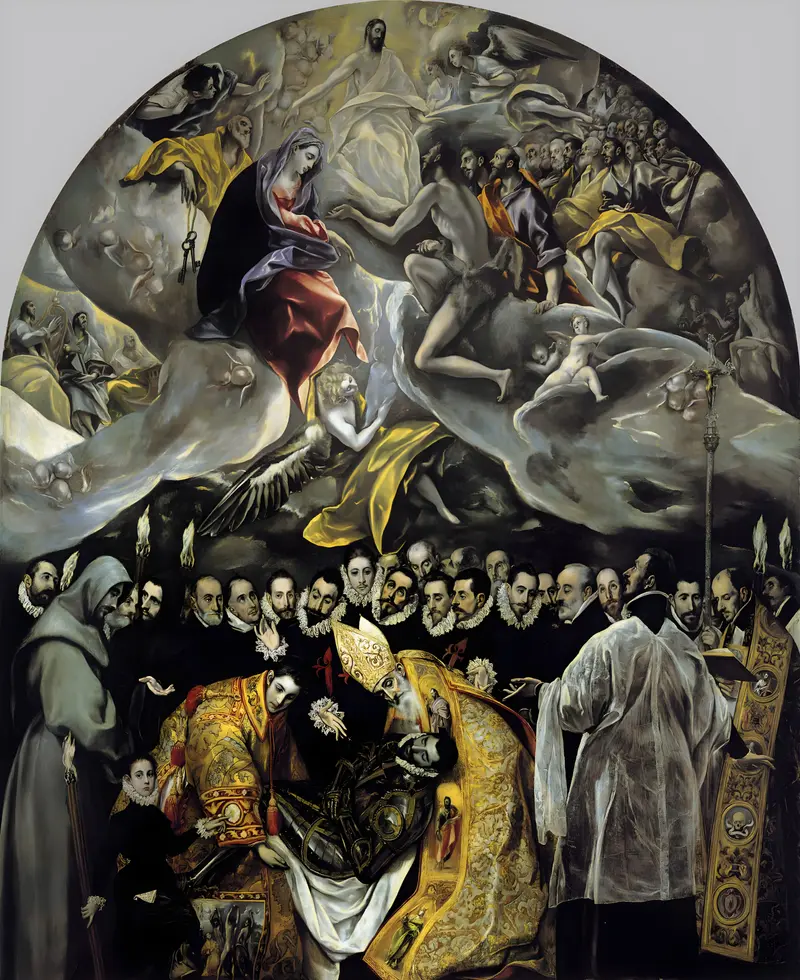
The Burial of the Count of Orgaz
El Greco

Portrait of an Apostle (Saint Philip)
El Greco

Saint Luke the Evangelist
El Greco

The Immaculate Conception
El Greco

The Feast in the House of Simon
El Greco

View of Toledo
El Greco

Saint Ildefonso
El Greco

The Disrobing of Christ
El Greco

The Vision of Saint John
El Greco

The Marriage of the Virgin
El Greco





