
Newton — History & Facts
When William Blake created Newton in 1795, he was not merely illustrating the famed scientist—he was staging a philosophical confrontation. Blake’s image was conceived as a direct challenge to the rising authority of science and rationalism in late 18th-century Britain, a time when Isaac Newton’s theories were transforming the very fabric of thought. Blake, a poet and printmaker as much as a painter, saw Newton’s influence as double-edged: a force of illumination, but also of limitation.
This work is one of several color prints Blake made in the 1790s, each hand-finished and unique, blurring the boundaries between painting, print, and illuminated manuscript. In the picture, Newton sits naked and alone on a rocky outcrop, hunched over a scroll and compass, his gaze fixed downwards. Blake captures the moment of scientific calculation, but strips it of grandeur—Newton’s body is muscular and idealized, yet he is oblivious to the vivid, organic forms of the rock beneath him. The compass, an emblem of reason and measurement, draws the viewer’s eye to the act of drawing a perfect circle, a symbol of rational order.
Yet the world around Newton is wild, colored in earthy reds and blues, suggesting the untamed creativity that Blake believed science ignored. Unlike Raphael’s harmonious depiction of philosophers in The School of Athens, Blake’s Newton is isolated, his intellect both powerful and self-limiting. The exact medium of Newton remains uncertain, though it is generally described as a monotype with watercolor and ink, a technique Blake developed to produce richly colored, one-of-a-kind images. The work was not commissioned; rather, it was part of Blake’s personal myth-making, intended for a small circle of admirers and collectors.
Over the centuries, Newton has moved through private hands and now resides in the collection of Tate Britain. Today, it is recognized as a cornerstone of Romanticism and a testament to Blake’s lifelong resistance to the mechanistic worldview of his age, standing as both a portrait of a genius and a critique of the very idea of genius itself.
More Artworks by William Blake
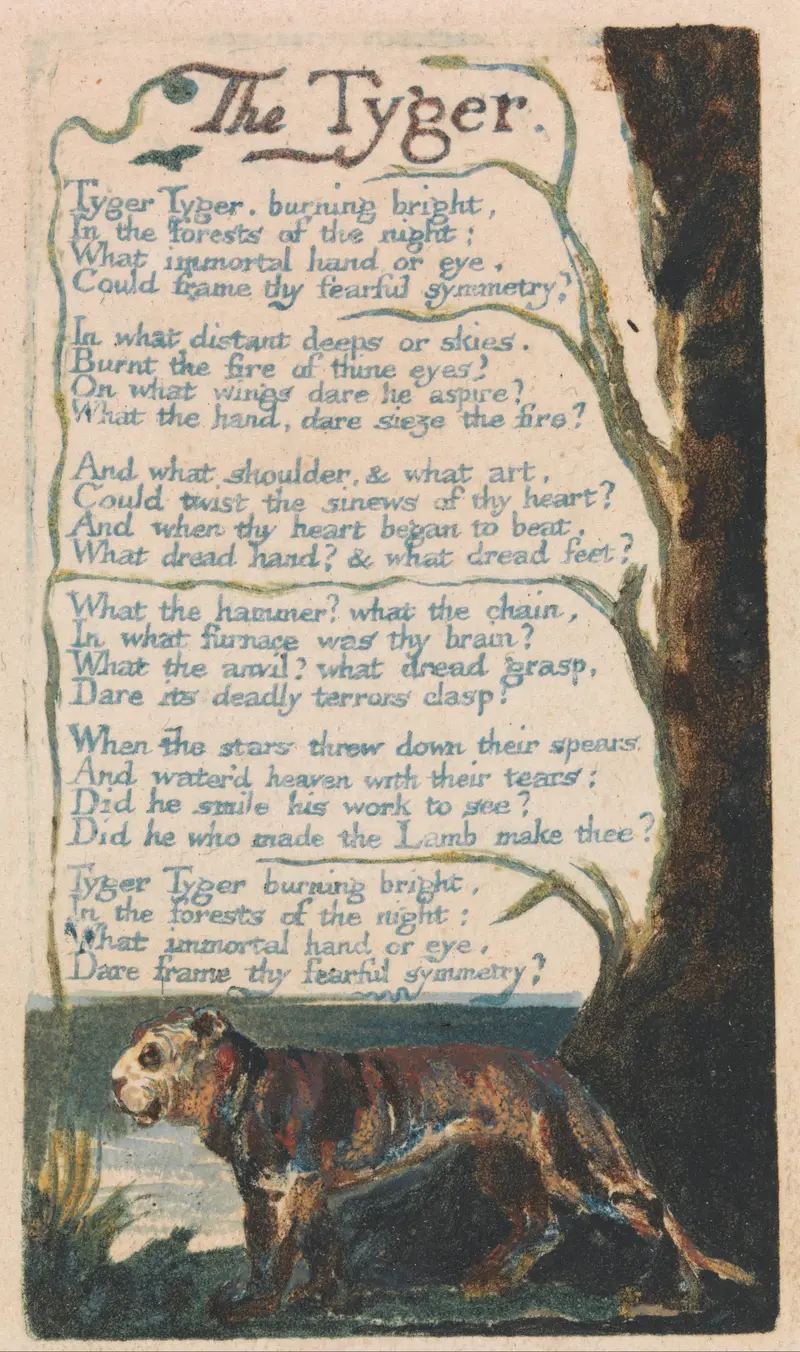
The Tyger
William Blake

Christ Blessing
William Blake
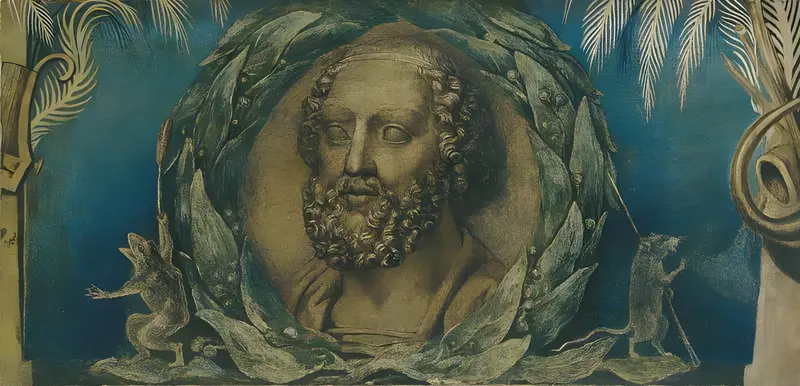
Homer
William Blake
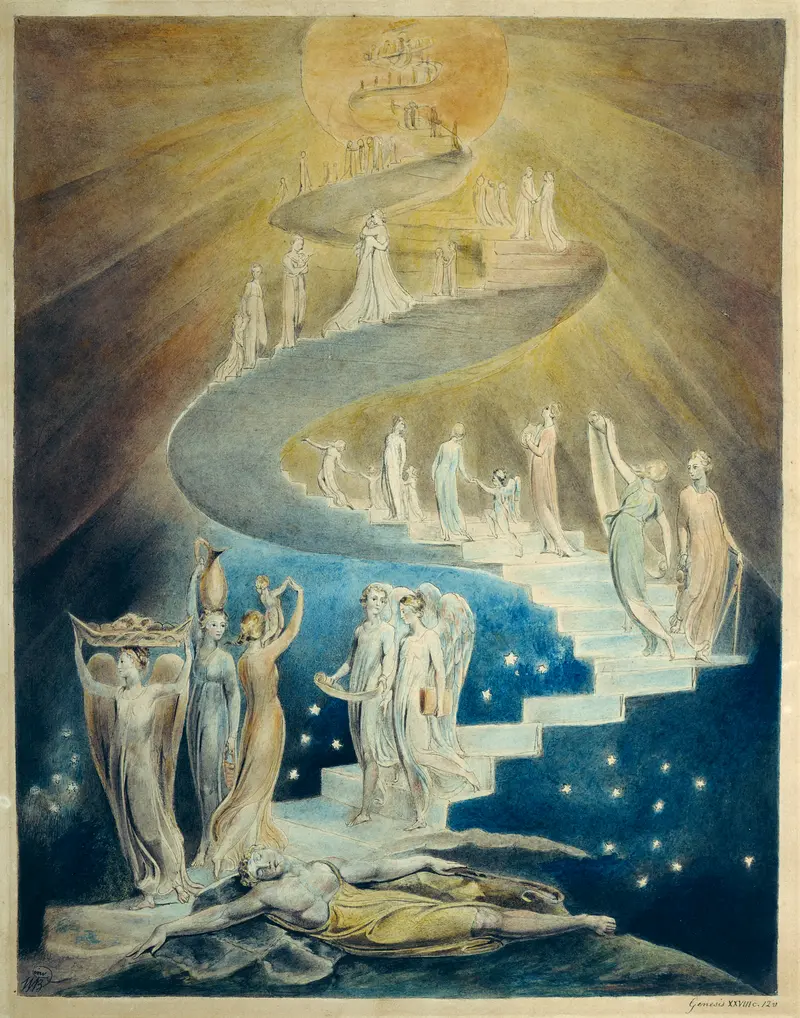
Jacob's Ladder
William Blake
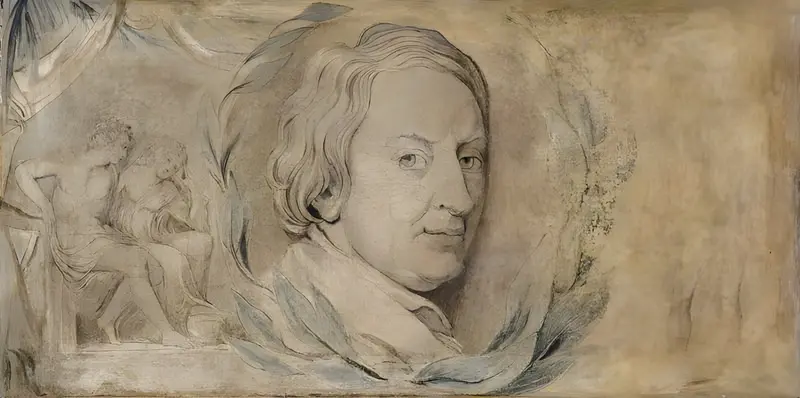
John Dryden (1631–1700)
William Blake
Landscape near Felpham
William Blake
Sacrifice of Job
William Blake
Christ's Entry into Jerusalem
William Blake
The Ancient of Days
William Blake
Adam Naming the Beasts
William Blake



