Portrait of William James Santiago Drake — History & Facts
What first draws the eye is the crisp authority of the sitter’s gaze, a look that seems to measure both the viewer and the world beyond the frame. Portrait of William James Santiago Drake by Auguste François Laby is a study in self-possession, every detail reinforcing the subject’s command over his domain. The quill poised in his right hand is no idle prop: it signals a man whose fortunes were built as much on calculation and correspondence as on coin.
The gleam of gold buttons and the richly embroidered chair root him in a world of privilege, yet it is the trio of ornate seals at his waist—yellow and green stones, gold, and a carved emerald—that quietly proclaim his international reach and the weight of his signature. This is a portrait that invites close inspection, rewarding the viewer with layers of meaning in the careful arrangement of objects and attire. The green bottle trousers and flannel waistcoat speak to the fashion of the early nineteenth century, but also to a certain practicality beneath the surface elegance. The high white collar and cravat frame a face marked by experience, the faint flush in the cheeks and the steady hand on the desk suggesting a man still very much at the helm of his affairs.
The light falls cleanly on his face and hands, drawing attention to his tools of trade: pen, paper, and the seals that authorized his will across borders. There is a quiet drama in the way the sitter leans slightly forward, as if caught in the midst of composing a decisive letter—a moment of action stilled for posterity. Such portraits, created in the early 1800s, were more than mere likenesses; they were declarations of status, ambition, and continuity. Painted in 1818, this work belongs to a period when international merchants like Drake shaped the destinies of families and nations alike.
The presence of his personal effects—later recorded in his posthumous inventory—anchors the painting in a documented reality, a rare bridge between image and archival trace. History has kept few traces of Auguste François Laby’s career, but here, in the confident bearing of Don Guillermo Santiago Drake del Castillo, the ambitions and anxieties of a new commercial age are preserved, inviting us to look again at the man behind the fortune.
More Artworks by Auguste François Laby

Sierra Leone
Auguste François Laby
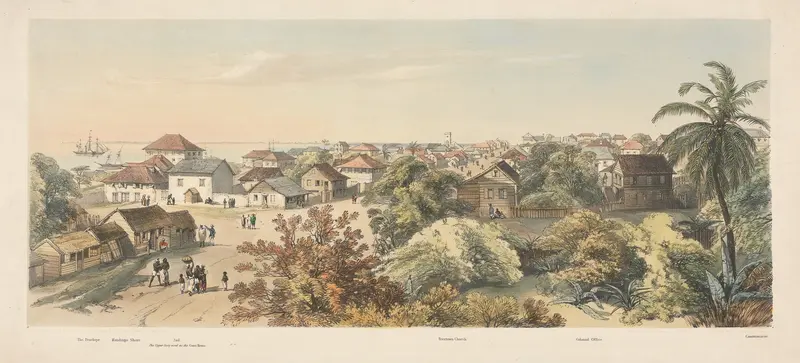
Freetown, Sierra Leone
Auguste François Laby
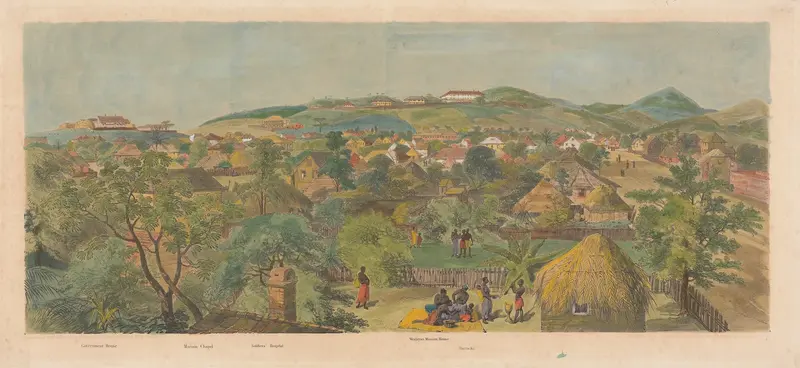
Freetown, Sierra Leone
Auguste François Laby
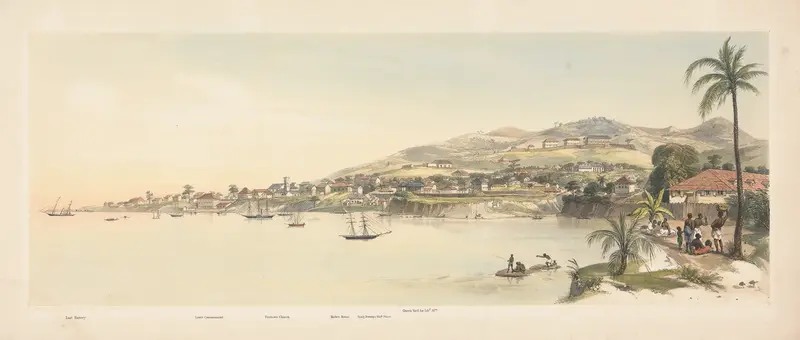
Freetown, Sierra Leone
Auguste François Laby
Freetown, Sierra Leone
Auguste François Laby
Freetown, Sierra Leone
Auguste François Laby
Freetown, Sierra Leone
Auguste François Laby
Freetown, Sierra Leone
Auguste François Laby