Rolf De Maré (1888-1964) — History & Facts
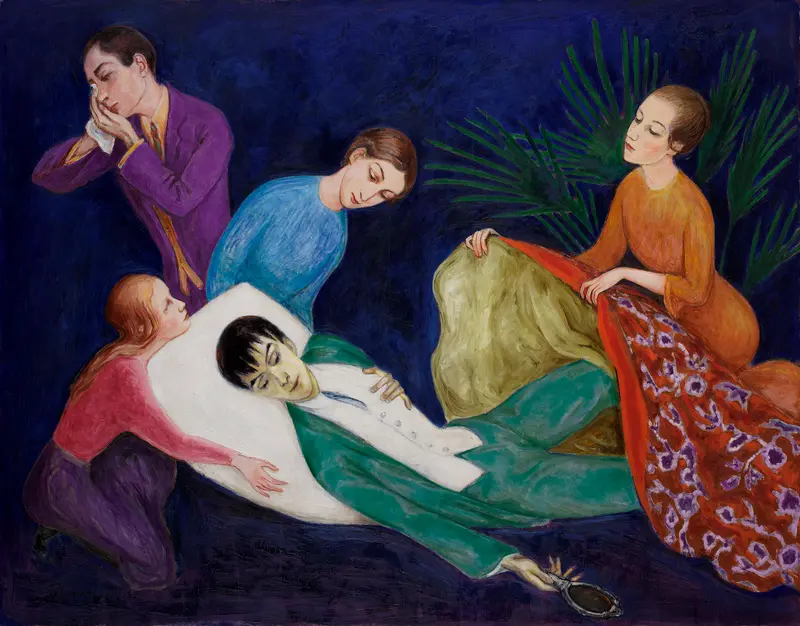
Few portraits capture the spirit of avant-garde Europe as vividly as Rolf De Maré (1888-1964) by Nils Dardel. The sitter, Rolf de Maré, was not only a wealthy Swedish patron but also the visionary founder of the Ballets Suédois, a daring rival to Diaghilev’s Ballets Russes in 1920s Paris. His circle included artists, dancers, and writers who shaped modernism’s restless energy.
The painting stands as a testament to the close personal and artistic ties between Dardel and de Maré, whose collaborations helped fuel the Swedish contribution to early twentieth-century dance and art. Dardel’s portrait fixes de Maré at a moment of poised self-possession, his gaze direct yet enigmatic. The sitter’s elegant attire and upright posture speak to his cosmopolitan identity, while subtle flourishes—perhaps a patterned tie, the glint of a ring—hint at the flamboyance that made him a fixture in Parisian salons. The background, if rendered in Dardel’s typical bright palette, would set the figure against a world both real and theatrical, echoing the stagecraft of the Ballets Suédois.
Unlike the introspective cool of Sargent’s society portraits, Dardel’s approach is more playful, infusing the scene with a sense of modernity and personal connection. The precise date and medium of Rolf De Maré (1888-1964) remain uncertain, and its early provenance is not fully documented. What is clear is that the portrait belongs to a period when Nils Dardel was at the height of his powers, moving between Sweden and France and painting the personalities who animated his world. Today, the work stands as both a likeness and a document of an era, often reproduced in studies of Swedish modernism and the Ballets Suédois.
Its survival ensures that the intertwined legacies of artist and patron remain visible to new generations, even as some questions about its creation endure.