Street in Montparnasse, Paris — History & Facts
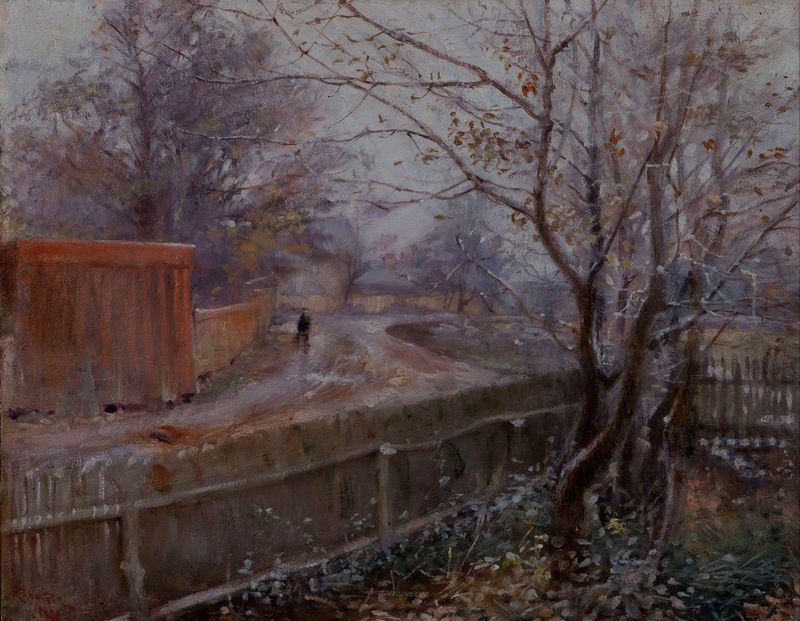
Where does light end, and longing begin? In the delicate interplay of shadow and illumination, a world of violence and quiet yearning emerges, inviting contemplation. Focus on the vibrant hues that dance across the canvas, particularly in the foreground where the cobblestone street glistens as if kissed by rain. Look to the left at the café, where patrons are silhouetted against the golden light spilling from the windows, creating a stark contrast against the encroaching twilight. Notice how the composition draws your eye along the path, leading to a distant horizon where the buildings fade into an ominous blue, suggesting stories untold and emotions buried beneath the surface. Here, Kreuger captures not merely a street but the soul of Montparnasse.
The juxtaposition of the warmly lit café and the cold shadows cast by the tall buildings creates a tension between safety and danger. The figures, though relaxed in their evening leisure, are enveloped by an atmosphere thick with the potential for violence, hinting at an undercurrent of unease that threads through everyday life. This blend of tranquility and anxiety evokes a longing for connection amid the chaos of existence. In 1884, Nils Kreuger was deeply immersed in the artistic currents of Paris, a city alive with creativity yet fraught with the struggles of modernity.
Painting during a time when Impressionism was reaching its zenith, he found inspiration in the urban landscape, capturing the fleeting moments of life in Paris. The streets of Montparnasse, teeming with bohemian energy, served as a canvas for his explorations of light and shadow, revealing both the beauty and the tension of the era.