
The Ancestors of Christ: Rehoboam and Abijah — History & Facts
A woman sits in profile at the center of the triangular spandrel, her head bowed and resting on her hand, with a young child pressed closely to her side. The woman wears a turban-like head covering and a robe of pink, orange, and cream, its folds painted with broad, curving strokes that suggest the weight and texture of the fabric. Her arm encircles the child protectively, and both figures are set against a muted brown background, which heightens the luminosity of their garments and skin.
Light falls from the left, casting gentle shadows that model the forms of the figures and bring out the sculptural quality of their bodies. The composition is tightly arranged within the triangle, with the figures filling almost the entire space and their poses echoing the angles of the frame. Two seated male nude figures appear in the rectangular panel above the spandrel, each facing outward with their backs partly turned to the viewer and their knees bent.
The nude figures are painted in warm ochre and brown tones, with visible brushwork that creates soft transitions of shadow and light across their muscular bodies. The background behind the central figures inside the triangle is softly blended, with no distinct objects or scenery, and transitions from a warm brown at the base to a cooler, more neutral tone above. The left and right corners of the triangular spandrel are filled with deep shadow, emphasizing the central grouping and adding depth to the composition.
The white architectural molding around the triangle is decorated with small, regularly spaced relief motifs resembling stylized leaves or shells. Light falls most strongly on the woman’s upper arm and the folds of her skirt, creating bright highlights and accentuating the volume of the drapery. The paint handling in the figures above the triangle is looser and more fluid compared to the more sculptural modeling of the central group, with visible, expressive lines defining their limbs and torsos. The entire scene is integrated into the architectural framework of the Sistine Chapel ceiling, with crisp white molding framing the spandrel and separating it from the surrounding painted figures. This fresco, The Ancestors of Christ: Rehoboam and Abijah, was painted by Michelangelo in 1511 as part of the Sistine Chapel ceiling.
Sources: Wikidata Q4009321 · Image source (Wikimedia Commons)
More Artworks by Michelangelo

Libyan Sibyl
Michelangelo
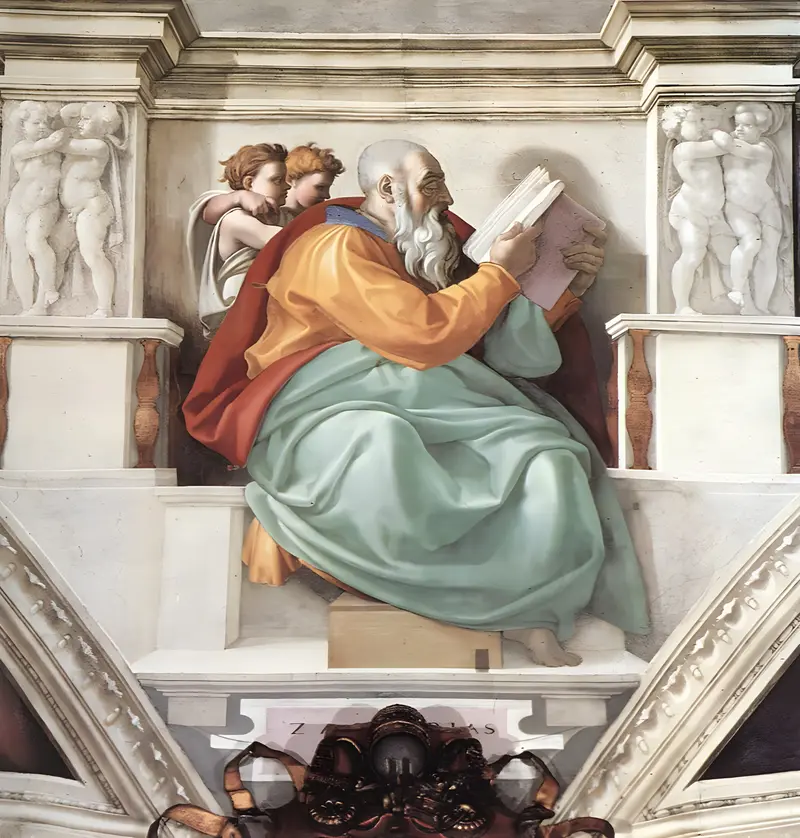
Prophet Zechariah
Michelangelo

Cumaean Sibyl
Michelangelo
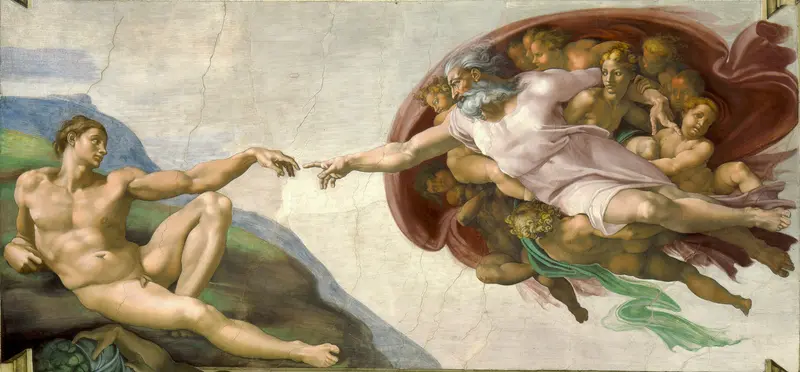
The Creation of Adam
Michelangelo
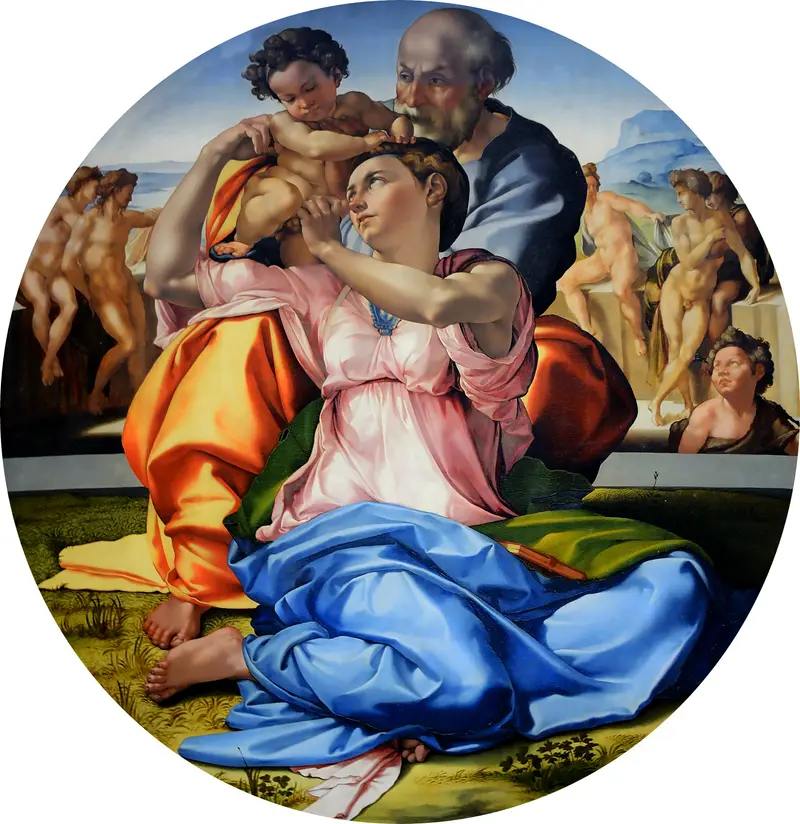
Doni Tondo
Michelangelo
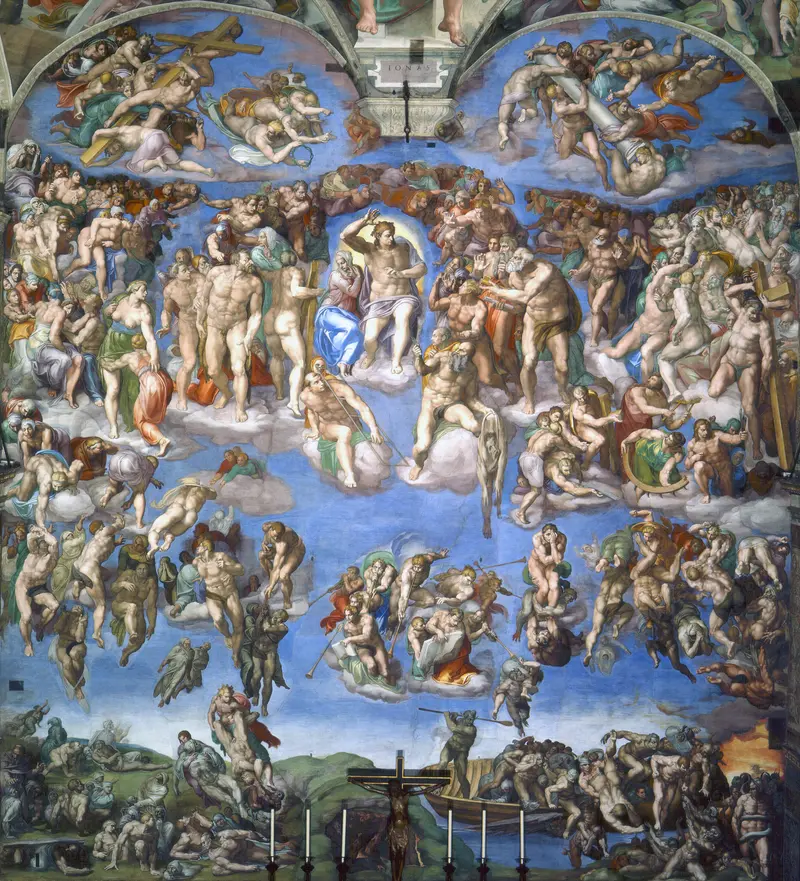
The Last Judgment
Michelangelo
Separation of Light from Darkness
Michelangelo
The Separation of the Earth and Waters
Michelangelo

Erythraean Sibyl
Michelangelo
Salmon, Boaz, Obed
Michelangelo




