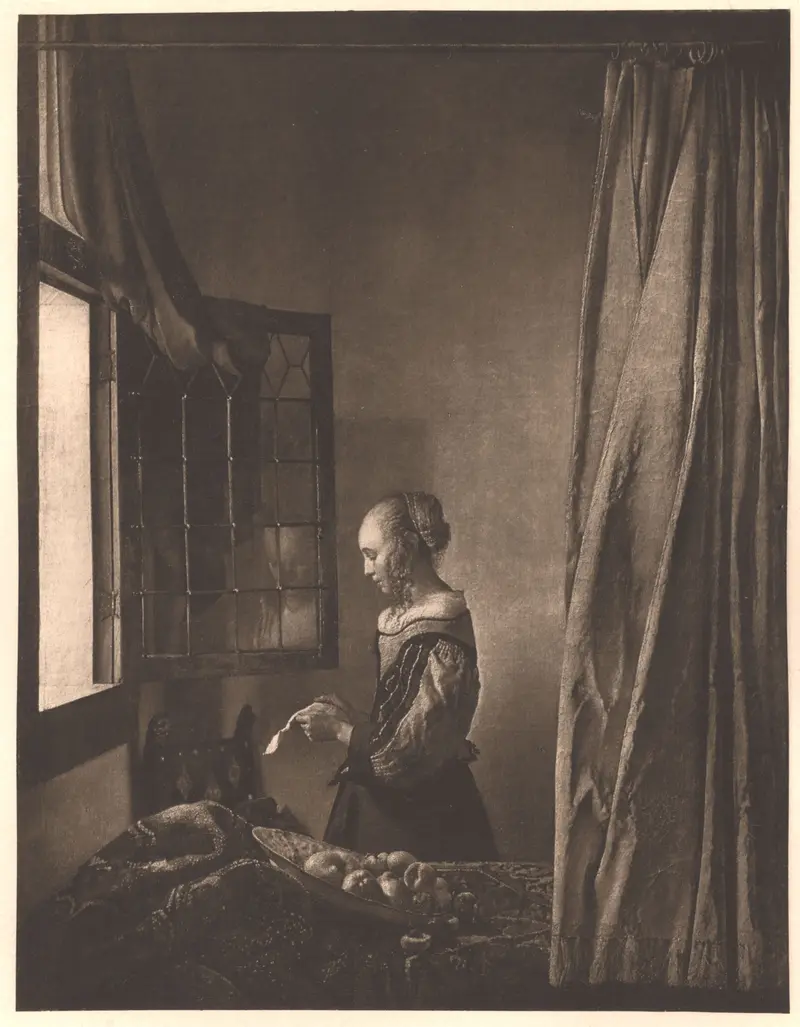
The Greenhouse — History & Facts
When The Greenhouse first appeared in the Impressionist exhibition of 1877, critics were divided—some marveled at its lush, humid atmosphere, while others derided its apparent lack of finish. What fascinated many was Renoir’s choice of subject: not a grand Parisian salon or a sunlit riverbank, but the intimate, glass-walled world of a greenhouse, a space where nature and artifice mingle. The painting’s air of enclosure and cultivated beauty sparked debate about modernity and leisure, with one reviewer noting, "Here, the garden is tamed, as if the painter wished to trap spring itself behind glass." In the context of a rapidly urbanizing Paris, this was a scene both familiar and quietly radical. Inside this shimmering enclosure, Renoir captures a fleeting moment: a woman, elegantly dressed, pauses amid the riot of green leaves and exotic blooms.
Her delicate gesture—perhaps adjusting a flower or lost in thought—draws the eye, while the dappled light, filtered through glass and foliage, dances across her figure and the surrounding plants. The greenhouse becomes both a sanctuary and a stage, its lush interior suggesting a private world of contemplation and cultivated pleasure. Unlike the formal garden scenes of Édouard Manet, Renoir’s approach is softer, more intimate, dissolving hard edges in a haze of color and light.
Every brushstroke seems to vibrate with the warmth and humidity of the space. The exact provenance of The Greenhouse is not fully documented, and its medium is still a matter of scholarly debate, though oil on canvas is likely. What is certain is that the work marks a pivotal moment in Pierre-Auguste Renoir’s career, as he explored new ways to render light and atmosphere in indoor settings. After its exhibition in Paris, the painting passed through several private collections before entering a public museum, where it now invites viewers to linger in its cultivated calm.
Today, The Greenhouse stands as a testament to the Impressionist fascination with modern life—not just its public spectacles, but its private corners, lush with possibility.
More Artworks by Pierre-Auguste Renoir

Jetée De Fleurs
Pierre-Auguste Renoir

Portrait of Madame Charpentier
Pierre-Auguste Renoir

Bal du moulin de la Galette
Pierre-Auguste Renoir

Dance at Bougival
Pierre-Auguste Renoir

Luncheon of the Boating Party
Pierre-Auguste Renoir

Mother and Child
Pierre-Auguste Renoir

Woman with a Hat
Pierre-Auguste Renoir

Femme Au Chapeau
Pierre-Auguste Renoir

Femme au Fauteuil Vert
Pierre-Auguste Renoir

Gabrielle, Jean et une petite fille
Pierre-Auguste Renoir