Utan pardon — History & Facts
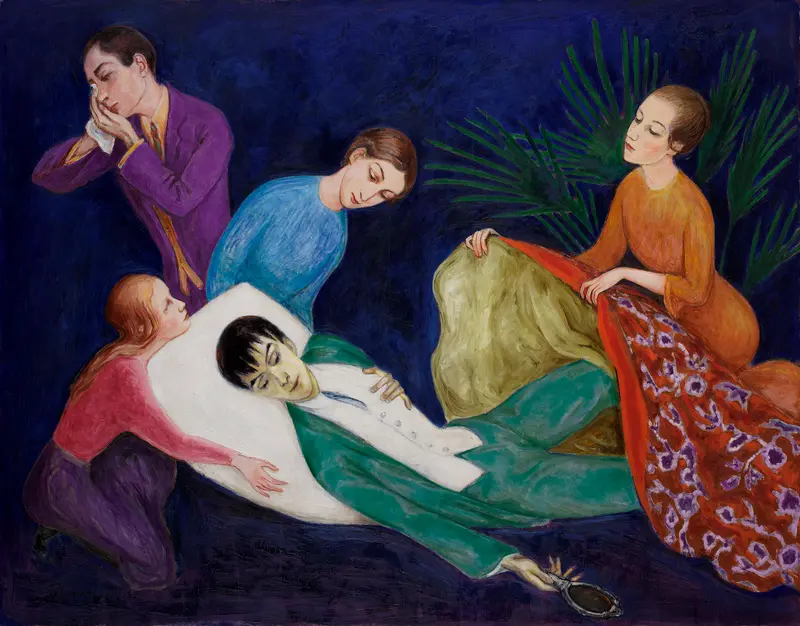
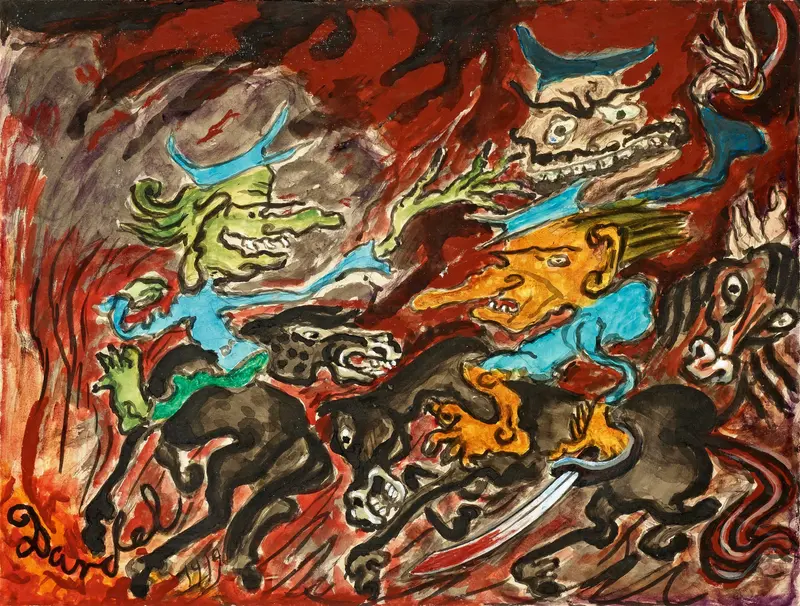
Utan pardon stands out in the career of Nils Dardel as one of his most enigmatic and debated works. The title, which translates as "Without Pardon," has prompted speculation among art historians about its meaning and possible inspiration—was it a response to a personal betrayal, a political statement, or a meditation on justice? No definitive documentation survives to clarify Dardel's intent, and the date and circumstances of its creation remain uncertain, adding to its aura of mystery. What is certain is that Utan pardon has provoked strong reactions since it first appeared in exhibitions, with viewers divided over its message and mood. The painting captures a moment of confrontation: a figure, perhaps an executioner or judge, stands over another who kneels in resignation or despair.
The drama is heightened by Dardel’s characteristically bold colors and stylized forms, which lend the scene a theatrical, almost dreamlike quality. The upright figure’s rigid posture and the sharp division of light and shadow suggest an unyielding verdict, while the kneeling figure’s bowed head and clasped hands evoke a plea denied. The absence of background detail focuses all attention on the emotional exchange, recalling the psychological intensity found in works by Edvard Munch, though Dardel’s palette and line are distinctly his own.
The chain or rope—if present—could symbolize inescapable fate or the finality of judgment. As with many works by Nils Dardel, the physical history of Utan pardon is not well documented. Its current location is not widely published, and it is unclear whether it resides in a public collection or remains in private hands. This lack of provenance has only deepened its intrigue among collectors and scholars of early twentieth-century Swedish art.
Within Dardel’s oeuvre, Utan pardon is often cited as an example of his fascination with existential themes and his ability to blend narrative with modernist form. Today, it continues to invite speculation and interpretation, a testament to Dardel’s enduring ability to unsettle and engage.