Variegated Trogon — History & Facts
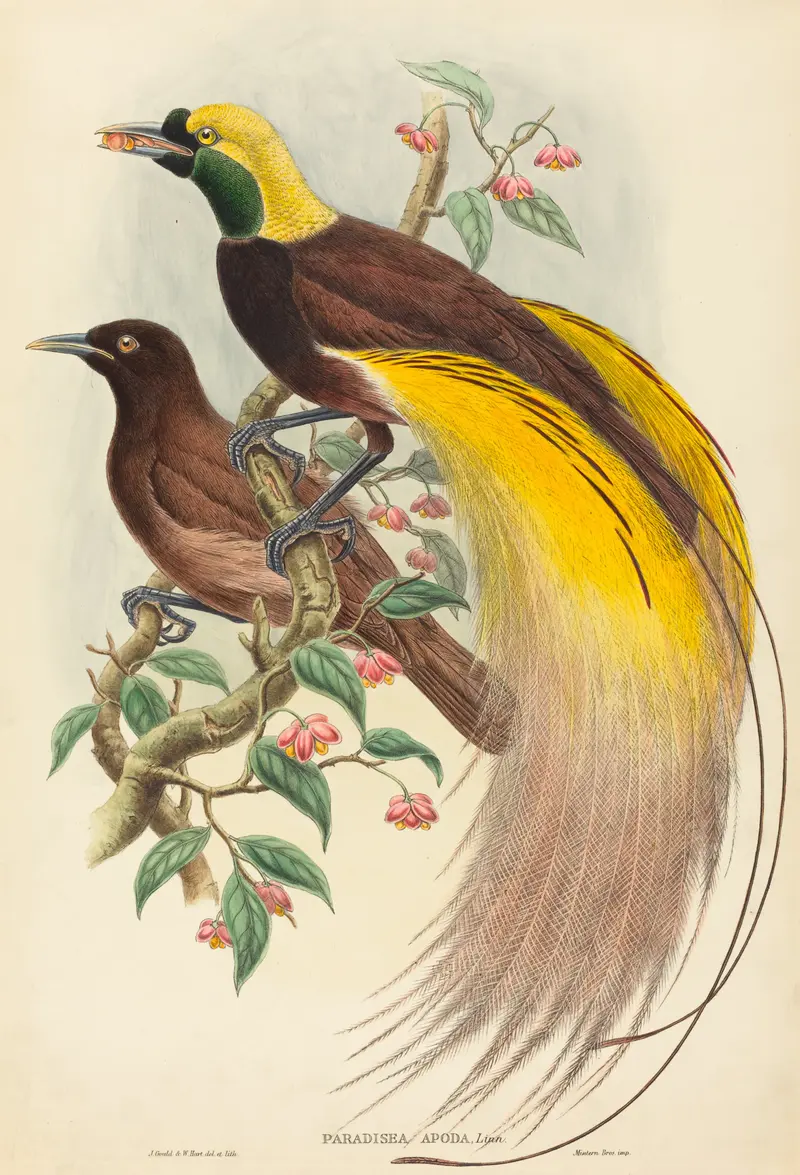
What first catches the eye in Variegated Trogon is the way three birds, each with their own distinct pose, seem to animate the page with a quiet sense of alertness and poise. Their feathers, rendered in a careful gradation of emerald, rose, and slate, shimmer against the pale background, while the delicate structure of the branch draws the viewer’s gaze in a gentle arc from one bird to the next. The artist’s attention to the subtle differences in posture—a head cocked, a tail extended, a beak slightly parted—transforms this from a static study into a moment of living observation.
The soft, almost glowing light isolates the birds, giving their jewel-like colors room to breathe and inviting the viewer to linger on every detail, from the scalloped bars of the tail to the blush of pink on each breast. This image belongs to the world of early nineteenth-century natural history, when explorers and artists alike were driven by a hunger to catalogue the wonders of distant continents. The probable date of 1836/1838 places John Gould at the heart of this movement, when ornithological illustration was both a scientific tool and a form of art. Such works were commissioned by collectors, scholars, and institutions eager to bring the marvels of the tropics home to European salons and libraries.
History has kept few traces of this particular sheet’s journey, but its presence today in the National Gallery of Art’s open-access collection is a testament to the enduring fascination these images hold. The next time you look, notice how the leaves and buds echo the birds’ colors—a subtle reminder that, for Gould and his contemporaries, every detail was a doorway to discovery.