
Venus — History & Facts
A single standing figure dominates the composition, filling nearly the entire vertical panel against a deep, dark background. She is depicted nude, her pale skin softly modeled with subtle gradations of light and shadow that give her form a gentle roundness. Her long, flowing hair falls in rippling waves past her shoulders and down her body, rendered in delicate, golden strands that catch the light.
With her left hand, she modestly covers her breast, while her right hand gathers her hair to conceal her lower body, a gesture that both reveals and veils. Her head tilts slightly to the left, and her gaze meets the viewer with a calm, enigmatic expression, her lips softly parted and her eyes framed by finely arched brows. The background is an uninterrupted field of deep blue-black, which isolates the figure and heightens the luminous effect of her skin and hair.
The surface of the painting shows smooth, controlled brushwork, with transitions of tone especially refined in the modeling of flesh and the soft shadows under her chin and arms. The composition is vertically oriented and symmetrical, with the figure placed precisely in the center, her upright stance and flowing hair forming a harmonious balance. No secondary figures or objects appear anywhere in the composition, leaving the central figure alone against the backdrop.
The background is a uniform, nearly black blue, with subtle variations in tone that suggest a painted surface rather than empty space. At the bottom edge of the painting, the figure stands on a narrow, pale gray platform or ledge that runs horizontally across the width of the panel. The toes of her left foot are curled slightly over the edge of the platform, while her right foot is placed flat, both feet rendered with delicate modeling and visible toenails.
The lighting falls from the left, casting a faint shadow along the right side of her body and under her left arm, while the left side of her torso and thigh are more brightly illuminated. The hair is painted with fine, undulating lines of gold and brown, with individual strands and curls distinctly outlined against the dark background and her skin. The edges and corners of the image are empty and unadorned, with the dark background extending uniformly to all sides, emphasizing the isolation and verticality of the figure. Venus was created by Sandro Botticelli in 1490, as stated by the museum's record.
More Artworks by Sandro Botticelli
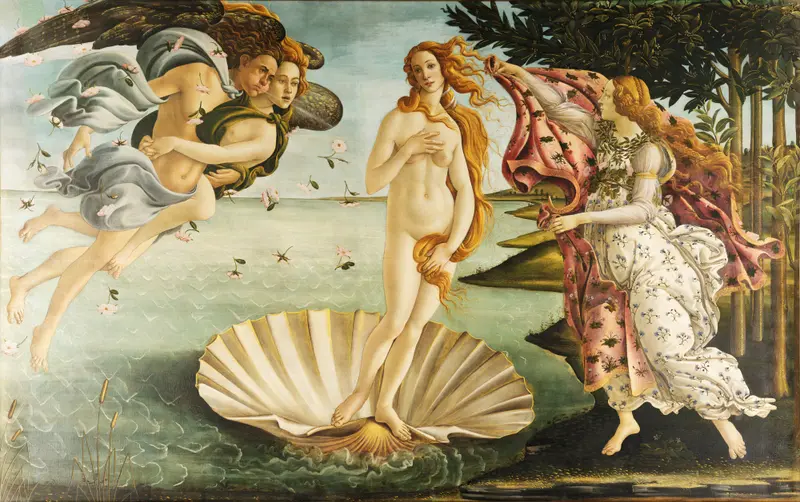
The Birth of Venus
Sandro Botticelli

Virgin and Child
Sandro Botticelli

Madonna and Child and the Young St John the Baptist
Sandro Botticelli

Madonna and Child with six angels and Saint John the Baptist as Child
Sandro Botticelli

Virgin and Child with the Young Saint John the Baptist
Sandro Botticelli
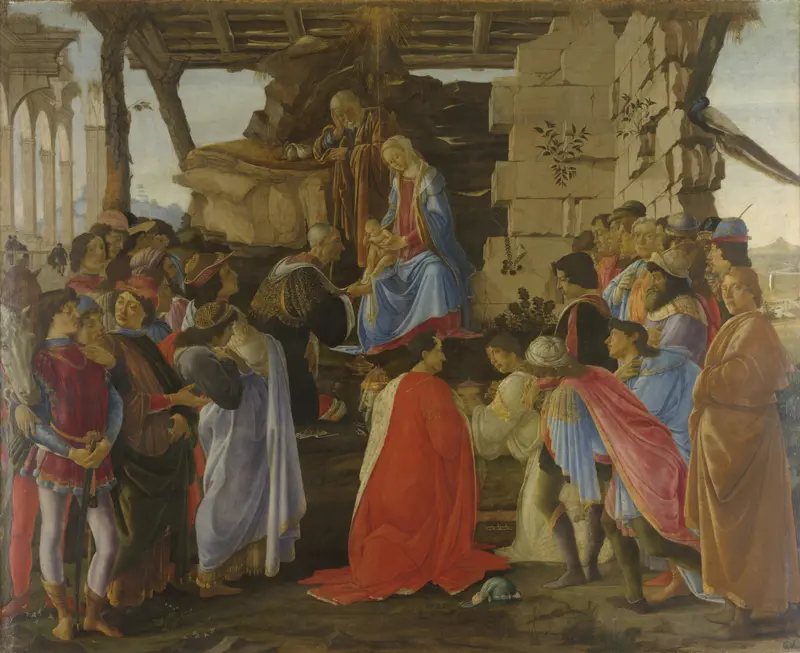
Adoration of the Magi
Sandro Botticelli
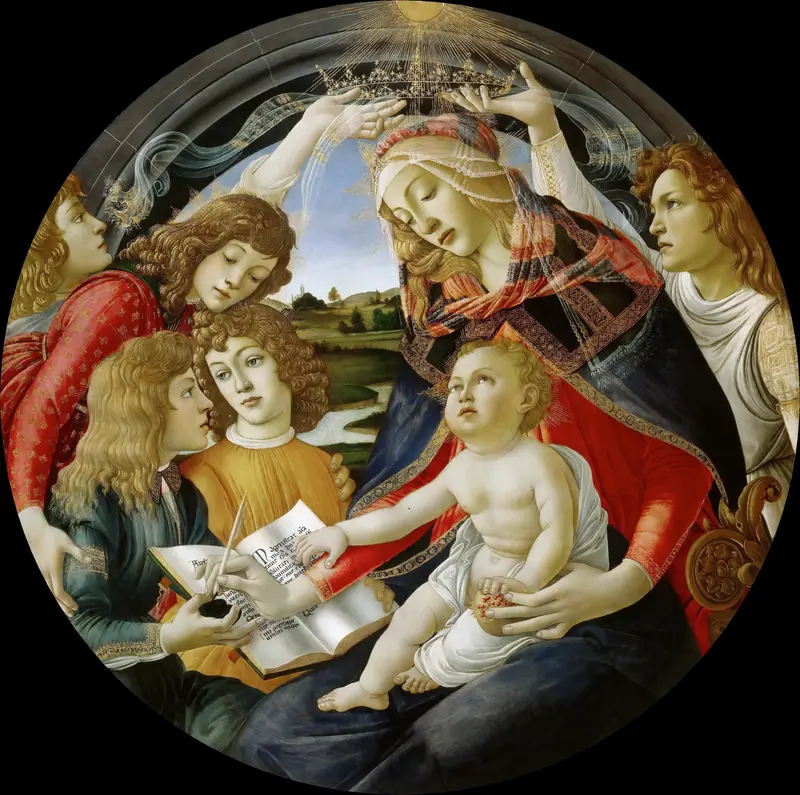
Madonna of the Magnificat
Sandro Botticelli
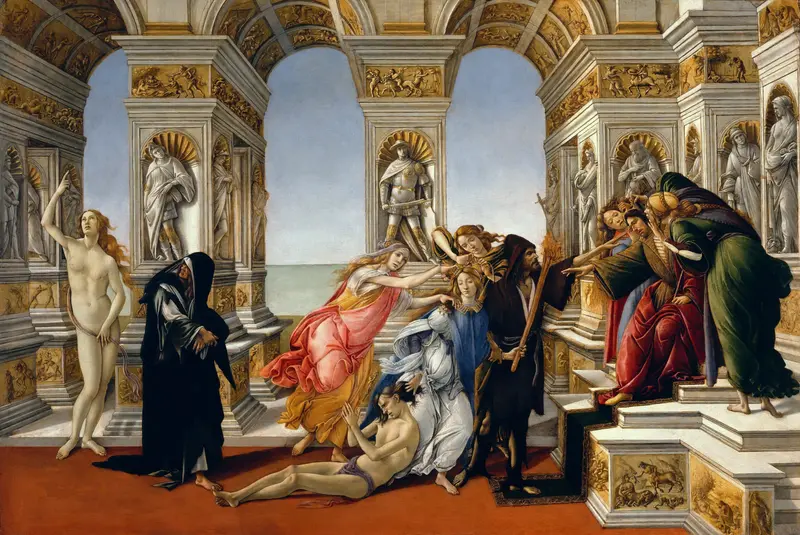
Calumny of Apelles
Sandro Botticelli

Idealized Portrait of a Lady (Portrait of Simonetta Vespucci as Nymph)
Sandro Botticelli

Portrait of a young man holding a roundel
Sandro Botticelli





