Wagler's Toucanet — History & Facts
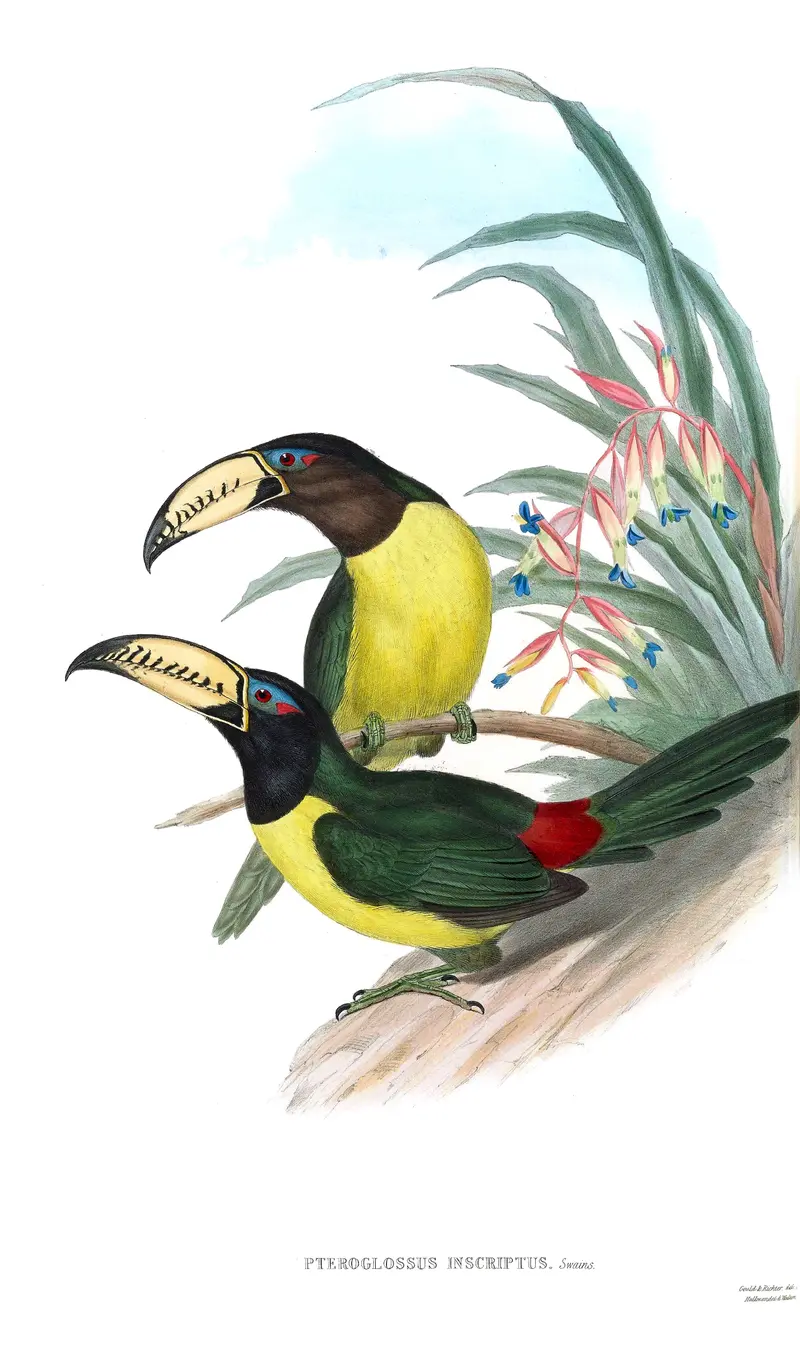
What first catches the eye in Wagler's Toucanet is the sheer clarity with which the bird seems to step out from the page, poised as if caught mid-conversation in its leafy world. The artist sets the toucanet against a field of white, heightening the drama of its emerald plumage and the improbable yellow arc of its bill. Every feather is rendered with a precision that suggests both scientific observation and a quiet admiration, while the branch and blossoms beneath its feet are drawn with a delicacy that invites the viewer to linger.
The toucanet’s alert posture, beak parted, hints at a moment of sound or movement just beyond our hearing, a reminder that this is a living creature, not merely a specimen. Created in 1854 for A Monograph of the Ramphastidæ, Or Family of Toucans, this image belongs to the golden age of natural history illustration, when explorers and artists worked in tandem to catalog the wonders of the world for a European audience hungry for the exotic. Such plates were not only tools for science but also objects of beauty, designed to inspire curiosity and wonder. John Gould, whose name appears on the source, was renowned for his lavish bird books, which combined meticulous taxonomy with lush, almost theatrical presentation.
History has kept few traces of the individual journey of this particular plate, but its presence in Gould’s monograph places it at the intersection of Victorian science, art, and the era’s restless desire to see and name the farthest corners of nature. The bird’s gaze and the soft wash of color still invite us back, urging a closer look at both the world it inhabits and the world that created its portrait.