Western Marsh Harrier — History & Facts
The first thing that grips the viewer in Western Marsh Harrier is the sense of alertness and purpose: two birds, their plumage rendered with almost scientific precision, are locked in a moment of predatory triumph. The sweep of the harrier’s wing and the taut curve of its talons pinning a snake to the grass tell a story of survival and skill. Every feather, every blade of marsh grass, is drawn with a clarity that invites close study, yet the composition is anything but static.
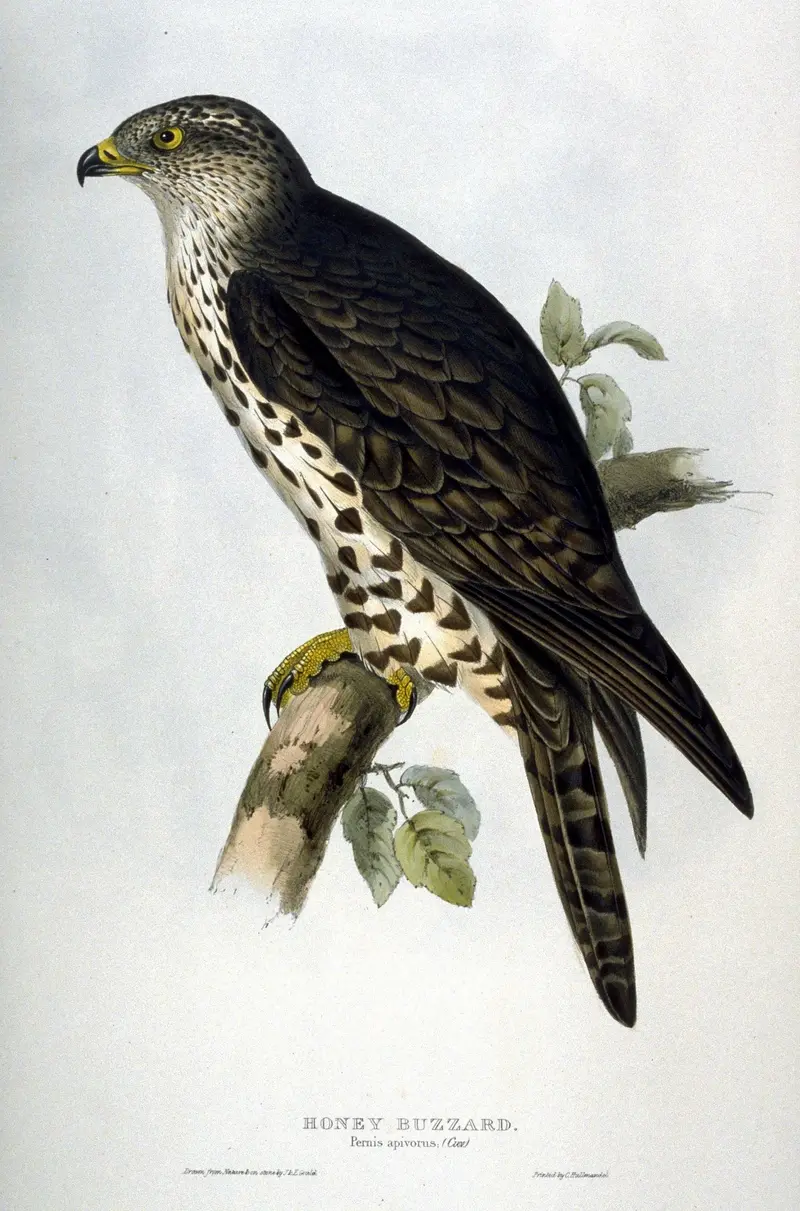
The eyes of both birds are fixed, intense, drawing the viewer into their world—a world where every movement matters, and the drama of life and death plays out in miniature. Created by John Gould for his monumental The Birds of Great Britain (London, 1873), this illustration belongs to a golden age of natural history, when explorers, artists, and scientists worked together to catalogue the living world. Such works were prized by collectors and scholars alike, serving both as scientific documentation and as objects of beauty. Gould’s illustrations, often produced with the help of skilled lithographers, were celebrated for their accuracy and vitality.
In this plate, the marsh setting, the careful attention to the birds’ anatomy, and the vivid depiction of their prey all speak to a period when the boundaries between art and science blurred, and the natural world was brought into drawing rooms and libraries for wonder and study. The longer you look, the more you sense the energy of the era—curiosity, ambition, and a reverence for the wild—alive in every line.