Yellow-billed Toucanet — History & Facts
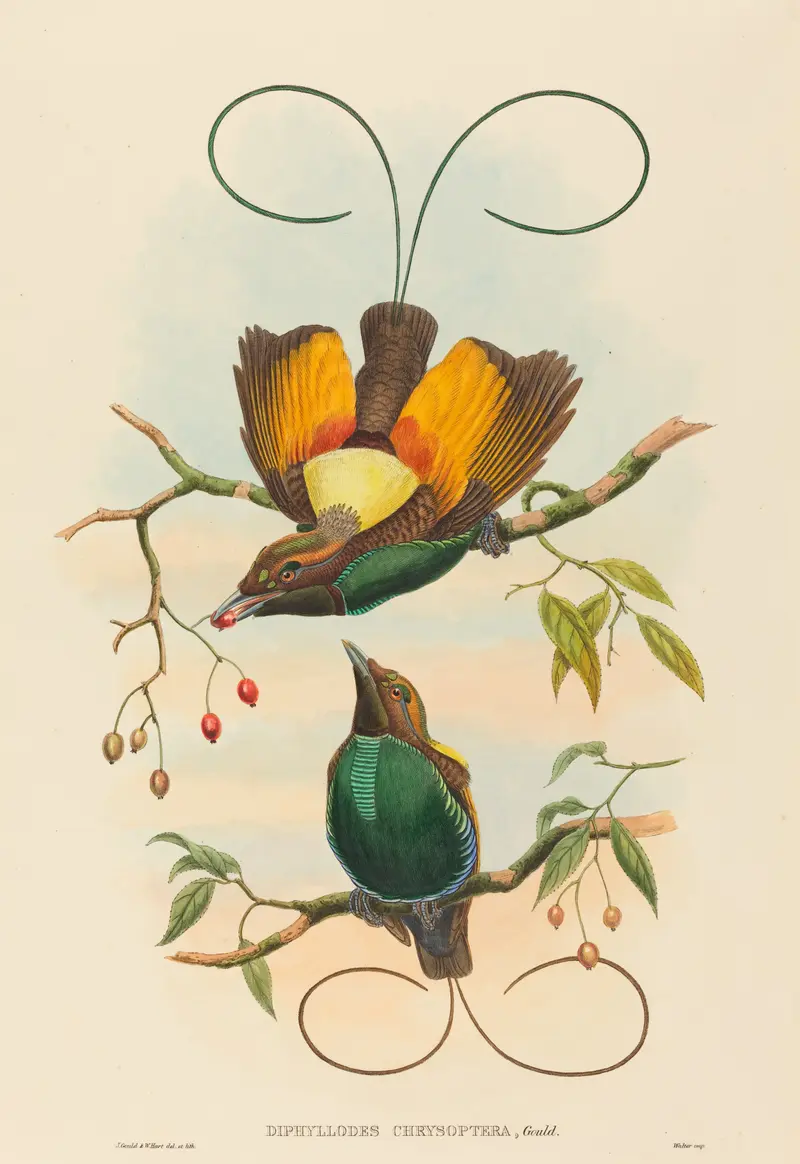
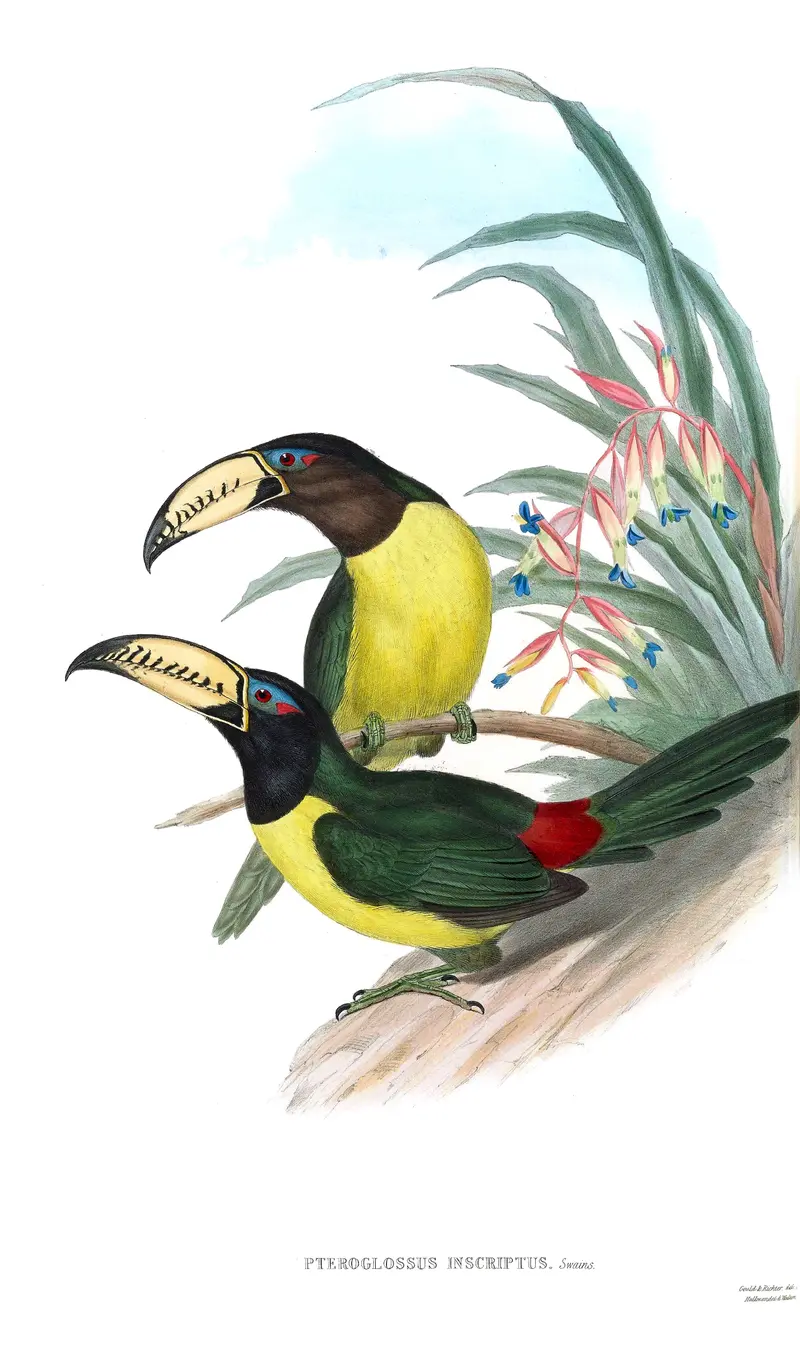
What first arrests the eye in Yellow-billed Toucanet is the electric clarity of its subjects: two birds, their feathers gleaming with every shade of green, blue, and gold, poised on delicate branches. The upper toucanet seems caught in a moment of sudden movement, wings half-raised as if startled or about to leap, while its companion below remains steady, beak forward, surveying the unseen world beyond the frame. The artist uses the arc of the branch and the mirrored curve of the birds’ bills to draw the gaze in a gentle spiral, inviting close inspection of each feather and the subtle play of shadow beneath the wings.
The creamy, nearly blank background isolates the pair, transforming a study of nature into a quiet drama of color and form. Created around 1870, this watercolored lithograph belongs to a golden age of natural history illustration, when explorers and scientists raced to catalog the world’s living wonders. Works like this, by John Gould, were not mere decoration—they were essential tools for knowledge, commissioned by collectors, scholars, and the curious elite of Victorian society. The precision and elegance of the image reflect the era’s blend of scientific rigor and artistic ambition, a time when the boundaries between art and science blurred on the page.
Though little is recorded about the specific journey of this sheet, its presence in a rare maps and prints collection today is a testament to the enduring power of close observation. Look again at the birds: every line and hue is a record of both a vanished world and the hand that sought to capture it.