Young Man In Black, Girl In White — History & Facts
No other painting by Nils Dardel has sparked as much speculation about its sitters as Young Man In Black, Girl In White. The identities of the elegantly dressed pair remain a mystery, fueling theories among art historians and collectors alike. Some suggest they may be Dardel’s friends from his cosmopolitan Parisian circle, while others see echoes of the artist himself and his muse, Thora Klinckowström.
The painting’s enigmatic aura is heightened by the absence of a date or clear provenance, leaving open the question of when, and for whom, it was created. This uncertainty has only increased its allure among admirers of early 20th-century Swedish art. A moment of silent tension seems to unfold between the two figures: the young man, dressed in black, stands with his back to the viewer, his posture rigid and formal, while the girl in white faces forward, her expression unreadable. The stark contrast between their clothing—his somber, hers luminous—suggests a meeting of opposites, perhaps a fleeting encounter or a farewell.
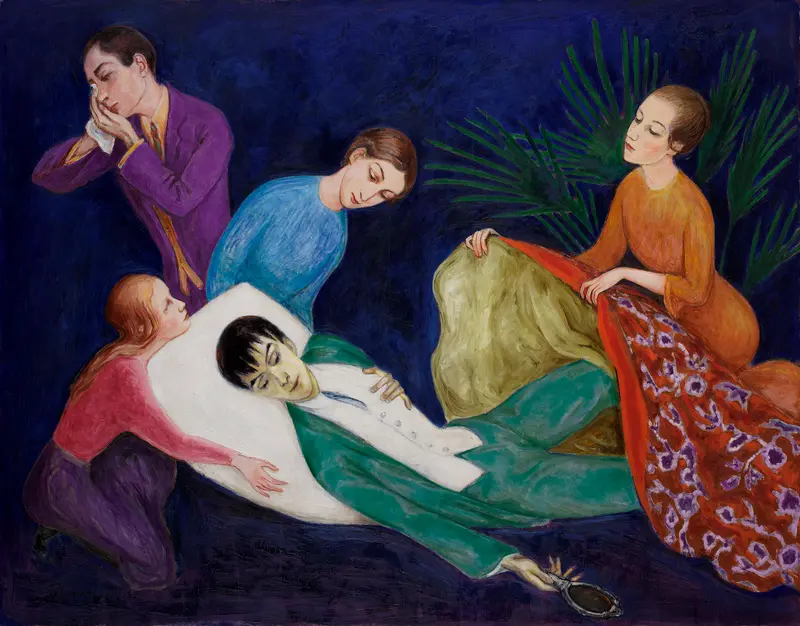
Dardel’s precise, almost theatrical arrangement of the figures recalls his fascination with staged emotion and ambiguous relationships, a theme also seen in his celebrated The Dying Dandy. The cool, even lighting and minimal background focus the eye on the psychological space between the pair, inviting viewers to invent their own narrative. The physical history of Young Man In Black, Girl In White is as elusive as its subject. Without a documented commission or early exhibition record, it likely remained in private hands for much of its existence, surfacing only in recent years as interest in Nils Dardel’s work has grown internationally.
Its current location is not widely published, typical for many of Dardel’s portraits, which often reside in private collections rather than public institutions. The painting’s unresolved mysteries—of date, medium, and identity—have made it a touchstone for those drawn to Dardel’s blend of modernity and psychological intrigue. It stands as a testament to the artist’s ability to capture the complexities of human connection in a single, unforgettable image.