Black-billed Sicklebill — History & Facts
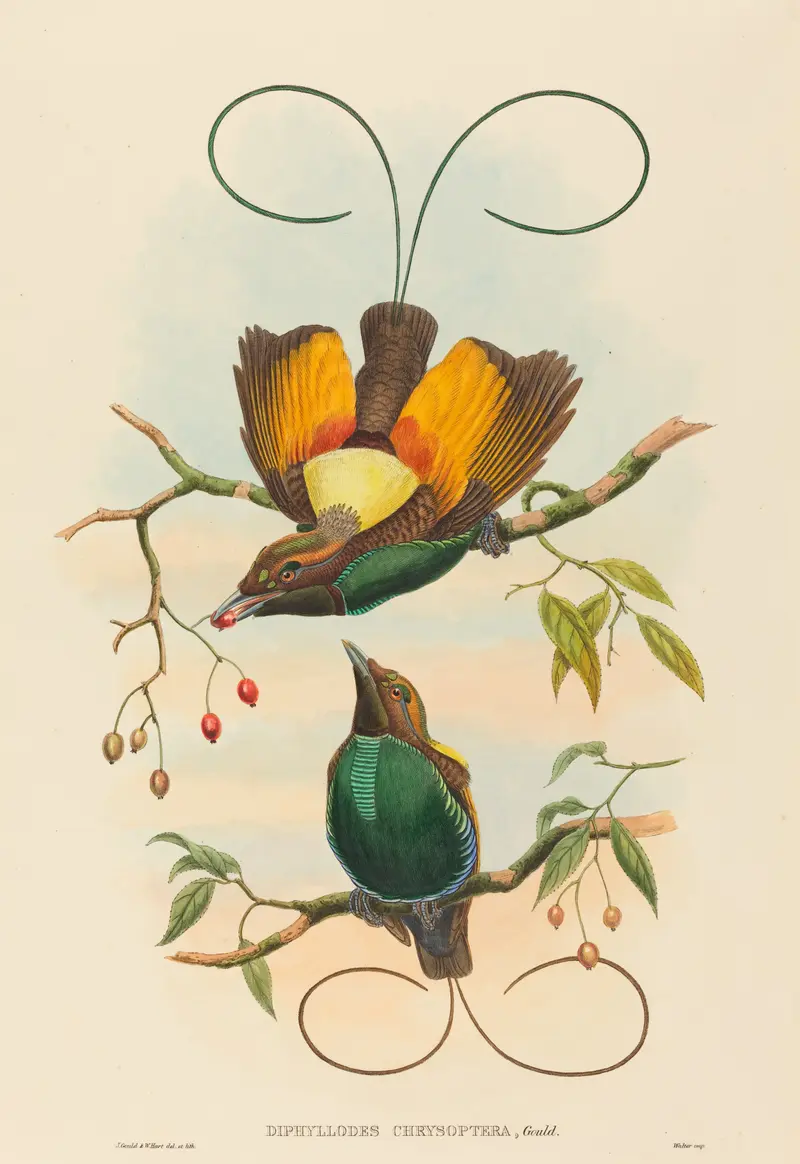
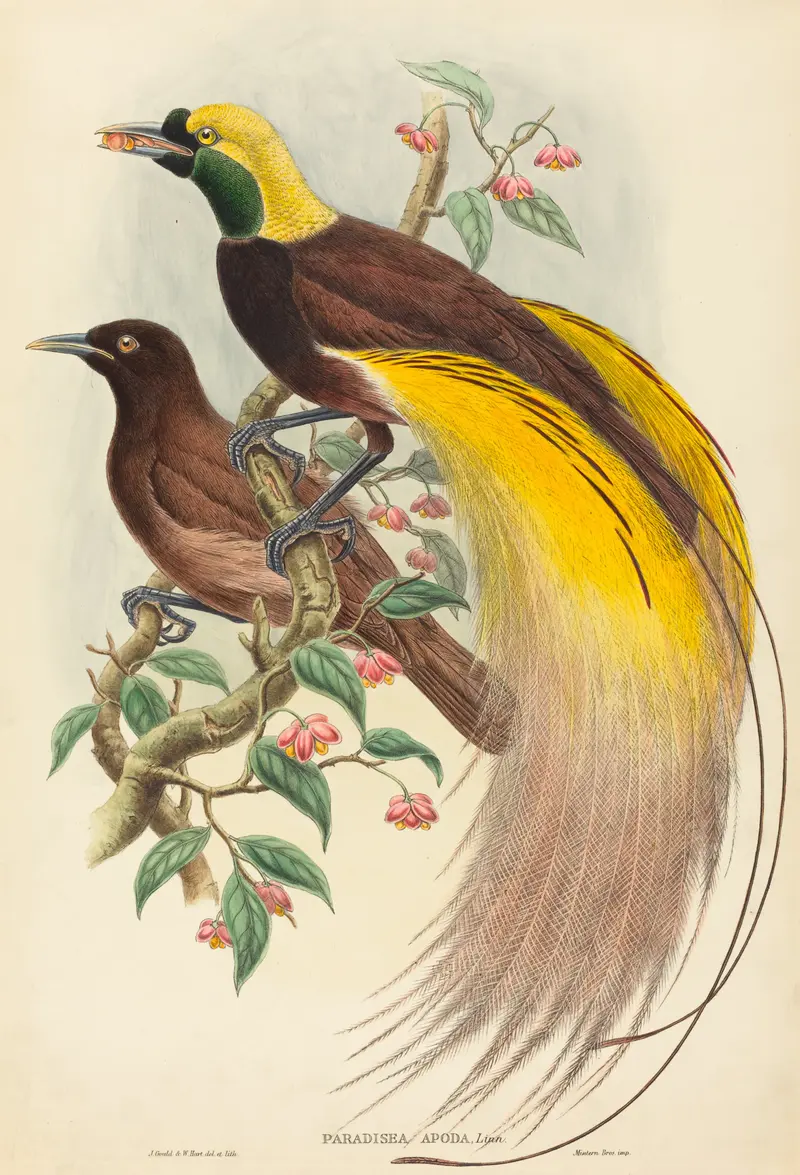
What first catches the eye in Black-billed Sicklebill is the improbable elegance of those curved beaks, mirrored in the arching stems and curling leaves that frame the birds. The larger bird’s spread wing flashes a fan of crimson, a signal as dramatic as a stage curtain, while the smaller companion nestles closer to the branch, its plumage softly striped and earth-toned. The artist’s hand lingers on every feather, coaxing out the velvet black, the sudden purple, and the almost metallic gleam of the crown.
The composition draws the viewer in, letting the eye wander from the sharp, improbable bill to the delicate yellow flower below, as if inviting us to imagine the birds’ next movement. There is a quiet tension here—display and concealment, the drama of nature’s pageantry caught in a moment of stillness. Works like this, produced in the age of exploration and scientific curiosity, served as both art and documentation. In the nineteenth century, naturalists and explorers commissioned such images to bring the marvels of distant lands into European salons and libraries.
John Gould became renowned for his lavish bird illustrations, which combined scientific rigor with a flair for the theatrical. This particular image, now in the collection of the National Gallery of Art and shared through their Open Access Policy, is part of that tradition—an intersection of science, art, and the imperial hunger for cataloguing the unknown. Today, the image stands as both a record and a celebration, inviting us to linger over the details that once astonished an audience seeing these birds for the very first time.