David and Goliat — History & Facts
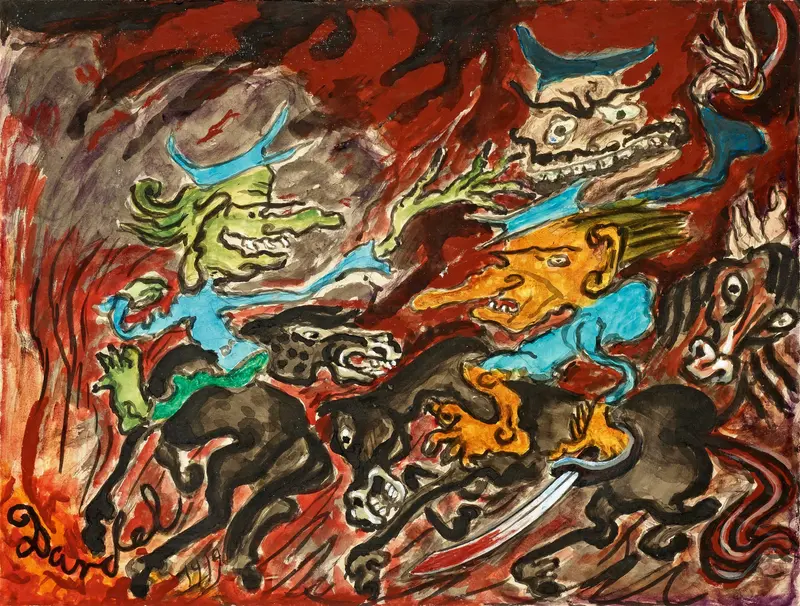
Few biblical duels have inspired as many retellings as the clash between David and Goliath, but Nils Dardel’s David and Goliat stands out for its enigmatic provenance—no date or commission is firmly established, and even its medium remains a matter of speculation among scholars. This air of mystery has only heightened interest in the painting, as Dardel, a Swedish modernist known for his vivid palette and psychological insight, rarely treated such overtly biblical themes. The work’s uncertain origins have led some to wonder whether it was a private experiment or a response to a specific, now-lost context in the artist’s life. Dardel chooses the instant after David’s improbable victory, when the young shepherd stands over the fallen giant.
Unlike the grand, theatrical violence of Caravaggio’s David with the Head of Goliath, Dardel’s composition is more introspective: David’s features are tense, almost uncertain, and the slain Goliath sprawls awkwardly, his armor rendered with a dreamlike distortion. The palette is bold, with sharp contrasts between the hero’s youthful skin and the monstrous bulk of his foe, perhaps hinting at the psychological weight of violence. The absence of a cheering crowd or divine light focuses attention on David’s internal reckoning, rather than on triumph or spectacle. The painting’s journey through history is as elusive as its origins.
No records tie it to a specific exhibition or patron, and it has surfaced only sporadically in catalogues of Nils Dardel’s work. This uncertainty has led to debate over its place in the artist’s career: was it a youthful experiment, or a late meditation on conflict and heroism? Today, David and Goliat is typically discussed in the context of Dardel’s broader interest in psychological drama and narrative ambiguity, and it remains a compelling outlier in his oeuvre, inviting viewers to ponder both the biblical story and the artist’s own.