Gräshoppan (the grasshopper) — History & Facts
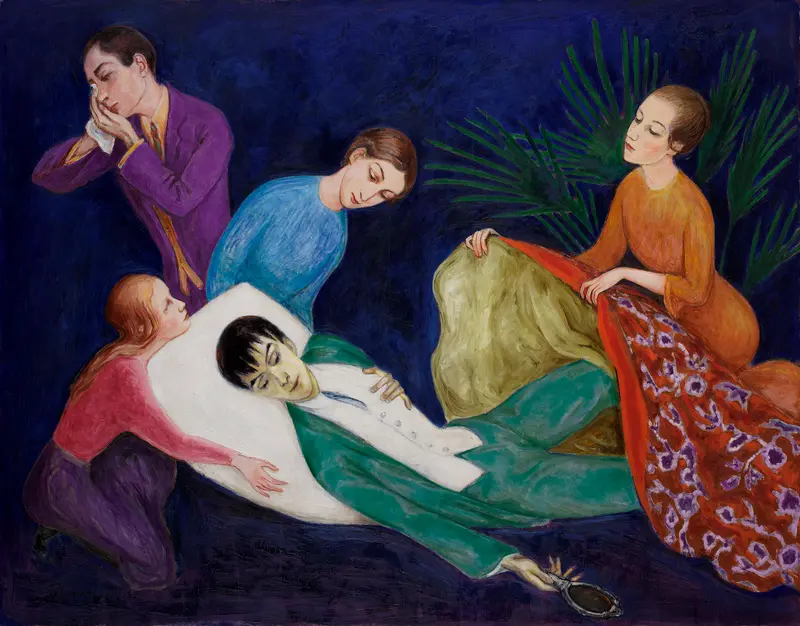
Few paintings by Nils Dardel have sparked as much speculation as Gräshoppan (the grasshopper), a work whose date and medium remain uncertain, yet whose playful title and enigmatic subject have drawn viewers and critics into lively debate. The painting’s very existence is a testament to Dardel’s fascination with whimsy and allegory, a trait that defined his career within the early 20th-century Swedish avant-garde. Unlike his celebrated The Dying Dandy, Gräshoppan has not been tied to any scandal or grand commission, but its elusive provenance and the scarcity of records surrounding it have made it a subject of intrigue among collectors and scholars alike. In Gräshoppan, Dardel captures a moment suspended between reality and fantasy: a grasshopper, rendered with human-like poise, occupies a central place in the composition, surrounded by a landscape that teeters on the edge of the surreal.
The insect’s elongated limbs and expressive eyes invite the viewer to read it as more than a simple creature—perhaps a symbol of fleeting joy, or a commentary on the fragility of existence. The bright, almost theatrical palette recalls the decorative flair of Henri Rousseau, yet Dardel’s grasshopper is less a part of nature and more a character on a stage. Each blade of grass, each shadow, seems carefully placed to heighten the sense of performance and artifice. The journey of Gräshoppan as an object remains largely shrouded in mystery; no definitive records of its first exhibition, patron, or early ownership have surfaced.
What is clear is that the painting embodies Dardel’s restless creativity during a period when he moved between Paris and Stockholm, experimenting with dreamlike imagery and narrative ambiguity. Today, Gräshoppan is recognized as a fine example of Dardel’s mature style, blending humor and psychological depth. Though it does not hang in a major public collection, reproductions and references to the work continue to circulate, ensuring its place within the ongoing conversation about Dardel’s legacy and the playful seriousness of early modern Swedish art.