
Hammamet with Its Mosque — History & Facts
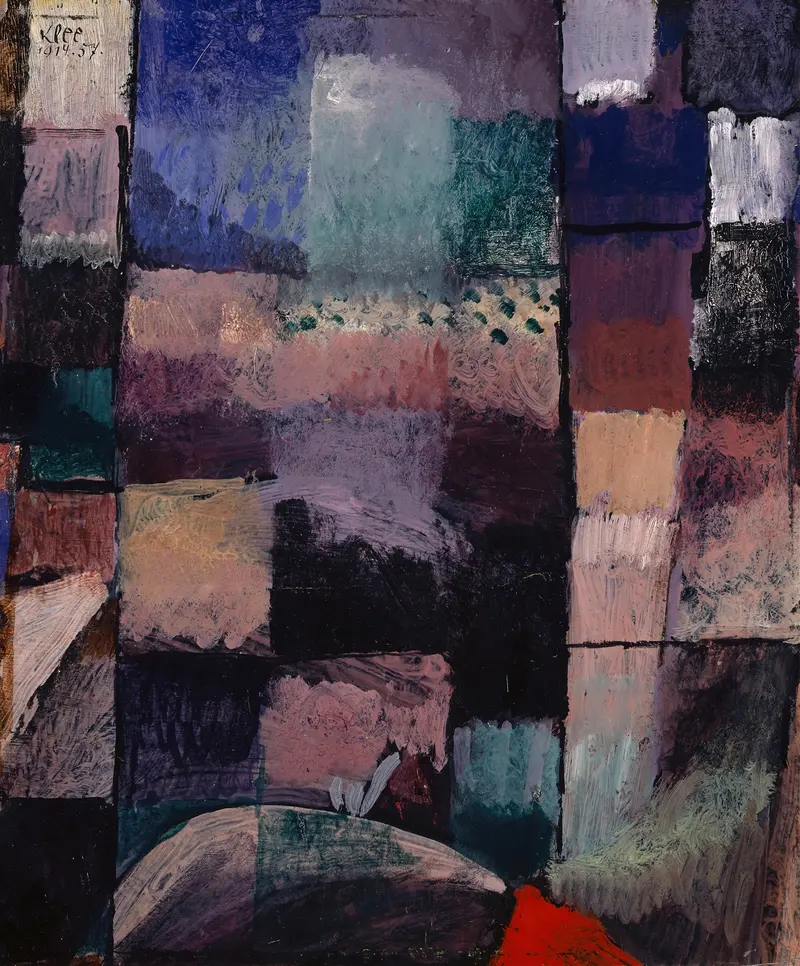
In Hammamet with Its Mosque, Paul Klee presents a colorful landscape filled with vibrant hues. The painting features a prominent mosque, characterized by its distinct architecture, set against a backdrop of rolling hills and a bright sky. Klee's use of bold colors creates a lively atmosphere, inviting viewers to explore the scene.
The interplay of shapes and colors reflects Klee's unique style and artistic vision. The painting is executed in oil on canvas, showcasing Klee's signature expressionist style. The composition is dynamic, with swirling forms and a rhythmic arrangement of elements that guide the viewer's eye. Klee's brushwork is loose and fluid, enhancing the sense of movement within the landscape.
The overall effect is one of harmony and balance, typical of Klee's approach to color and form. Paul Klee, a key figure in the Expressionist movement, created this work around 1914 during his travels in North Africa. This painting reflects Klee's fascination with the region's culture and architecture, particularly the mosque's design. An interesting fact about this work is that it embodies Klee's exploration of color theory, as he sought to convey emotions through his use of color.
The piece remains a testament to Klee's innovative approach to landscape painting.
More Artworks by Paul Klee

More Landscape Art

The Starry Night
Vincent van Gogh

View of Delft
Johannes Vermeer

Water Lilies
Claude Monet

The Grand Canal, Venice, looking north-west from the Ca' Corner to the Ca' Contarini degli Scrigni, with the campanile of Santa Maria della Carità
Canaletto

Windsor Castle
Canaletto

The Grand Canal looking North-East from the Palazzo Dolfin-Manin to the Rialto Bridge
Canaletto