
Horsemen at the Foot of the Chiffa Cliffs — History & Facts
What secret hides in the quiet of the canvas? In Horsemen at the Foot of the Chiffa Cliffs, a palpable yearning radiates from the brushstrokes, beckoning the viewer to delve into an unseen world. Look to the left at the rugged cliffs, their imposing forms rendered in deep ochres and earthy browns, standing as silent sentinels over the landscape. Notice the figures of the horsemen, their silhouettes defined against the stark backdrop, hints of movement captured in their poised stances. The muted hues of their clothing harmonize with the surrounding earth, yet the use of light—soft and diffused—illuminates the scene just enough to evoke a sense of both calm and tension.
The composition draws your eye to the interplay between the riders and the monumental cliffs, suggesting a struggle against nature’s grandeur. Within the canvas lies a palpable contrast between the strength of the horsemen and the immensity of the cliffs, a metaphor for humanity's relentless drive against nature. The stillness among the figures belies an inner tumult, as if they are contemplating their journey or destiny. The soft brushwork conveys the brush of the wind, while the distant horizon hints at adventures beyond the slopes, encapsulating a moment suspended between ambition and introspection. Eugène Fromentin painted this work in the 19th century, influenced by his travels in North Africa, where he captured landscapes that reflected both beauty and challenge.
During this period, he sought to bridge the gap between European artistic ideals and the exotic allure of the unfamiliar, contributing to the burgeoning genre of Orientalism. Fromentin's own quest for meaning and connection in these foreign lands infused his work with a sense of longing that resonates profoundly through this particular canvas.
More Artworks by Eugène Fromentin
Browse all →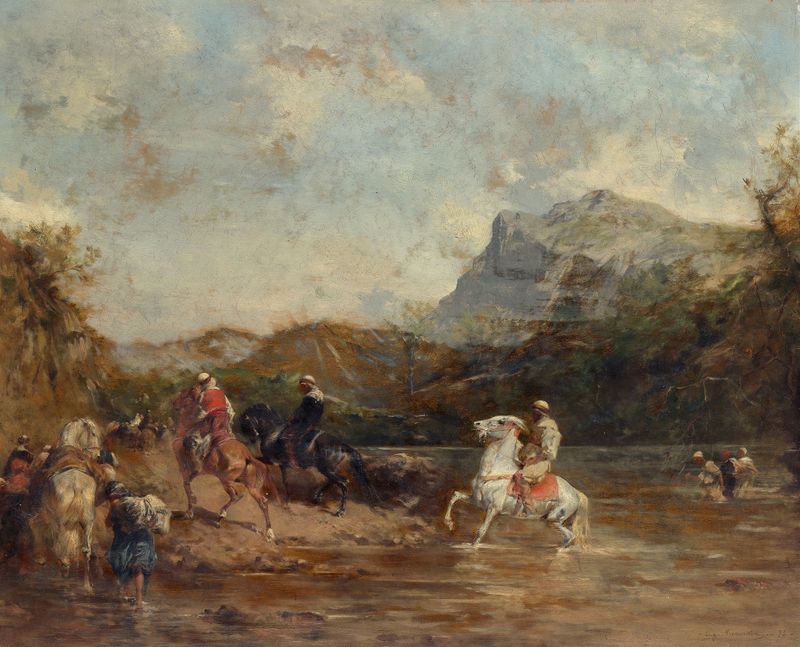
Arabs Crossing a Ford
Eugène Fromentin

Campement arabe dans les montagnes de l’Atlas
Eugène Fromentin

Falcon Hunt (‘Algeria Remembered’)
Eugène Fromentin

Women of the Ouled Nayls
Eugène Fromentin
An Arabian Camp
Eugène Fromentin

On the Nile
Eugène Fromentin
Felucca Au Bord Du Nil
Eugène Fromentin
On the Nile, Near Philae
Eugène Fromentin

Arabs watering their horses
Eugène Fromentin

A view of Donzère
Eugène Fromentin





