
King Charles I of England (1600-1649), three-quarter portrait — History & Facts
A man stands turned slightly to his left, gazing directly at the viewer with a composed and dignified expression. His brown hair falls to his shoulders, framing a pale face with a pointed beard and mustache. A crisp, white ruff encircles his neck, its pleats rendered with fine, delicate brushstrokes that catch the light.
He wears a dark doublet slashed with white, the sleeves puffed and striped, and a blue ribbon crossing his chest. A medal on a blue ribbon hangs at his chest, painted with sharp detail and highlighted by the surrounding deep shadows. His left hand rests at his waist, the fingers elegantly splayed, while his right hand lightly clasps the hilt of a sword, which glimmers at his side.
A metallic insignia with radiating lines is attached to his left side, its gold tones catching the warm light from the right. Behind him, a heavy curtain of rich brown and gold provides a backdrop, its folds loosely painted and glowing with subtle highlights. The composition places the figure off-center, allowing the detailed costume and insignia to dominate the foreground, while the background recedes into darkness.
The surface shows soft transitions between light and shadow, especially on the face and hands, with a smooth handling of paint typical of the Baroque style. The lower right corner reveals the textured, metallic surface of the sword's hilt, which catches a bright glint of light. The left edge of the painting is dominated by deep shadow, obscuring much of the background and part of the figure's sleeve.
Subtle gold highlights shimmer along the folds of the curtain in the upper right, contrasting with the otherwise dark and muted backdrop. The blue of the ribbon across the chest is echoed in a faint blue-gray sash tied at the waist, painted with loose, fluid brushstrokes. Anthony van Dyck paints this portrait of Charles I of England in 1632, depicting the monarch at three-quarter length. The portrait belongs to the Baroque movement, as noted by the museum’s catalogue.
Sources: Kunsthistorisches Museum, record GG_483 · Wikidata Q3937484 · Image source (Wikimedia Commons)
More Artworks by Anthony van Dyck

Portrait of a Man
Anthony van Dyck

Portrait of Anne, Lady Russell, later Countess of Bedford (1615-1684)
Anthony van Dyck

Portrait of Francisco de Moncada, Marqués de Aytona
Anthony van Dyck

Portrait of Charles I, King of the Great Britain (1600-1649)
Anthony van Dyck

Portrait of Sir Robert Howard, K.B. (1626-1698)
Anthony van Dyck

Charles I (1600-49) on Horseback
Anthony van Dyck

An Equestrian Portrait of Charles I (1600–1649)
Anthony van Dyck

Equestrian Portrait of Charles I
Anthony van Dyck

Self-portrait with a Sunflower
Anthony van Dyck
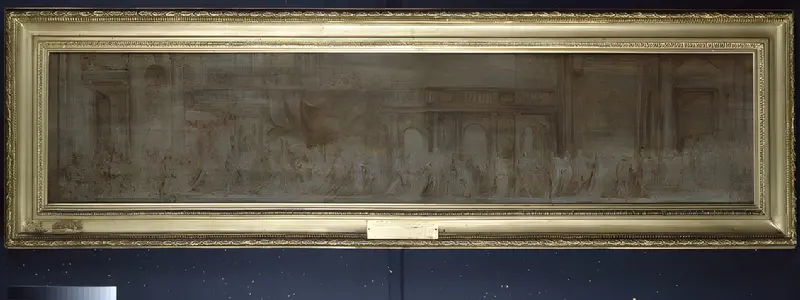
Charles I and the Knights of the Garter in Procession
Anthony van Dyck





