
Madonna at the Fountain — History & Facts
A woman in a flowing blue robe stands at the center, cradling a nude child who nestles against her cheek and reaches one hand to her face. The woman’s eyes are lowered in a gentle, contemplative expression, while the infant’s gaze turns upward, his left hand clutching a string of prayer beads that dangles from her wrist. Behind them, a richly embroidered red cloth of honor, patterned with gold foliage and animals, is suspended vertically and held aloft by two angels.
The angels, one on each side, wear long robes—one in red and the other in a pale gold—and both have multicolored wings and golden halos, their hands raised to support the textile. To the left foreground, a stone fountain rises, its clear water spilling into a shallow basin that reflects the light and the surrounding greenery. The figures are set in a walled garden, where roses and irises bloom densely around the base of the cloth, their petals meticulously rendered in delicate brushstrokes.
The composition is tightly framed, with the Madonna and Child dominating the small panel, their forms nearly filling the space from top to bottom. Every detail, from the gold embroidery to the glistening water and the tiny white flowers at the Madonna’s feet, is painted with extraordinary precision and clarity. Madonna at the Fountain was created by Jan van Eyck in 1439, and is recognized as his last signed and dated painting. Madonna at the Fountain belongs to the tradition of Early Netherlandish painting, a movement noted for its meticulous technique and devotional imagery.
Sources: Royal Museum of Fine Arts Antwerp, record 411 · Wikidata Q838074 · Wikipedia: Madonna at the Fountain · Image source (Wikimedia Commons)
More Artworks by Jan van Eyck

Adam
Jan van Eyck
Madonna of Chancellor Rolin
Jan van Eyck
The Arnolfini Portrait
Jan van Eyck
Ghent Altarpiece
Jan van Eyck

Dresden Triptych
Jan van Eyck

Madonna with Canon Joris van der Paele
Jan van Eyck

Prophet Zacharias; Angel of The Annunciation
Jan van Eyck
Portrait of a Man (Self Portrait?)
Jan van Eyck
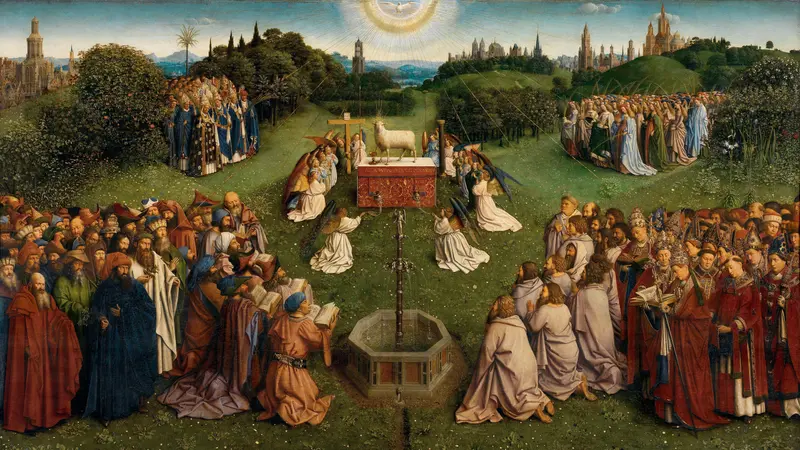
Adoration of the Lamb from the Ghent Altarpiece
Jan van Eyck
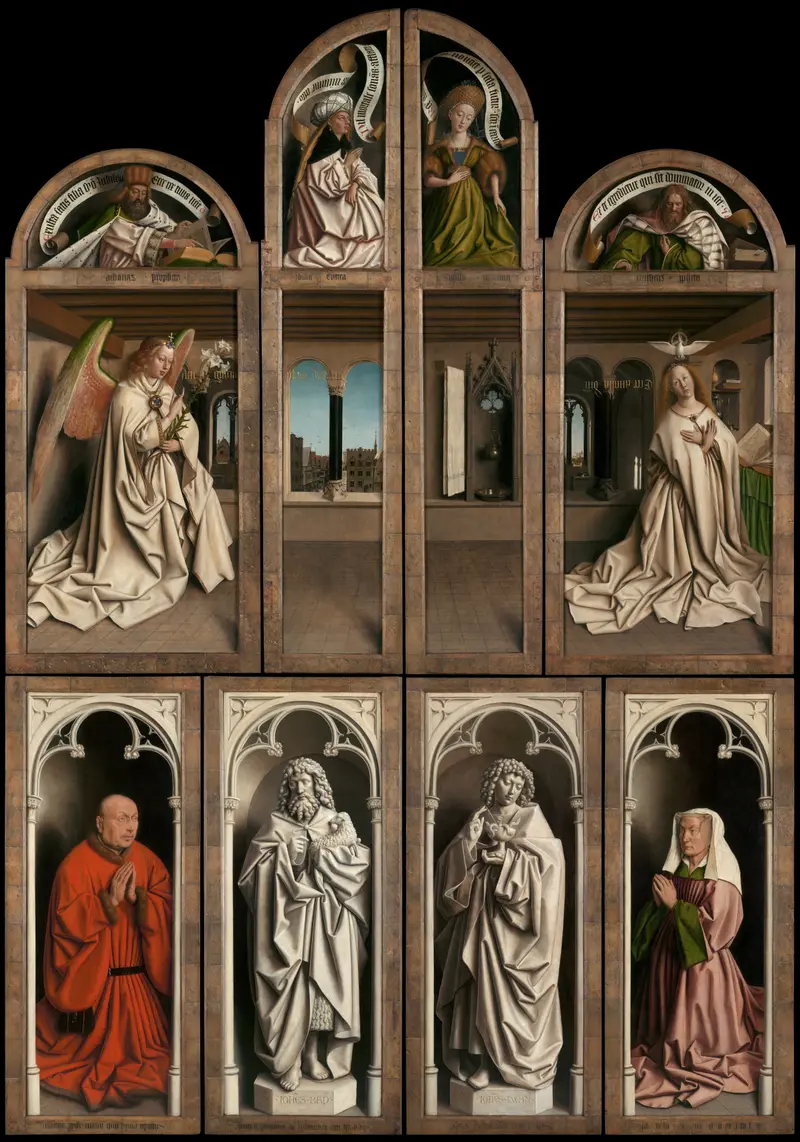
The Ghent Altarpiece (wings closed)
Jan van Eyck





