
Merahi metua no Tehamana — History & Facts
A young Tahitian girl sits frontally, her gaze steady and direct, her shoulders squared in a pose of quiet formality. She wears a high-collared dress with bold, vertical blue and white stripes and a delicate lace trim at the collar, a style associated with missionary influence in Tahiti. Her hands rest in her lap, holding a pale pink Samoan fan with a woven pattern, the fingers rendered in broad, sculptural strokes.
The paint surface is textured and the brushwork visible, especially in the stripes of the dress and the background, where the jute canvas shows through in places, lending a rough, tactile quality to the work. The composition is tightly framed, with the figure filling most of the space and the background elements arranged in shallow bands behind her. Light falls evenly across the scene, illuminating the girl's face and hands, and casting subtle shadows that model her form.
A stylized figure with red skin and long dark hair appears in the left background, standing with arms raised and an ambiguous expression. Behind the main figure, two additional faces are visible: one in profile with muted brown tones and another partially obscured, both rendered in a more abstract manner. A band of yellow glyph-like symbols stretches horizontally across the top portion of the background, contrasting with the muted grey-green wall.
Two large, round fruits in shades of orange and red are placed at the lower left edge, partly cropped by the frame. The upper right corner of the painting is filled with a flat, olive-brown color, interrupted only by the yellow glyphs. The light falls most strongly on the girl's face and the front of her dress, leaving the background figures in deeper shadow.
The blue stripes of the dress are painted with visible, loose brushstrokes, creating a sense of movement and texture. A red flower is tucked behind the girl's right ear, while white blossoms are woven into her hair on the opposite side. The lower right edge of the canvas shows the girl's sleeve and hand dissolving into broad, gestural strokes, blending into the dark background. The title Merahi metua no Tehamana is inscribed in the lower left, just above the fruit, along with the artist's signature and the date 1893.
Sources: Art Institute of Chicago, record 1980.613 · Wikidata Q19894296 · Wikipedia: Merahi metua no Tehamana · Image source (Wikimedia Commons)
More Artworks by Paul Gauguin

Self Portrait
Paul Gauguin

Three Tahitian Women
Paul Gauguin

When Will You Marry?
Paul Gauguin

Where Do We Come From? What Are We? Where Are We Going?
Paul Gauguin

Nave Nave Mahana
Paul Gauguin

Fatata te Miti (By the Sea)
Paul Gauguin

Three Tahitians
Paul Gauguin

Breton Girls Dancing,Pont-Aven
Paul Gauguin

Nave Nave Fenua
Paul Gauguin
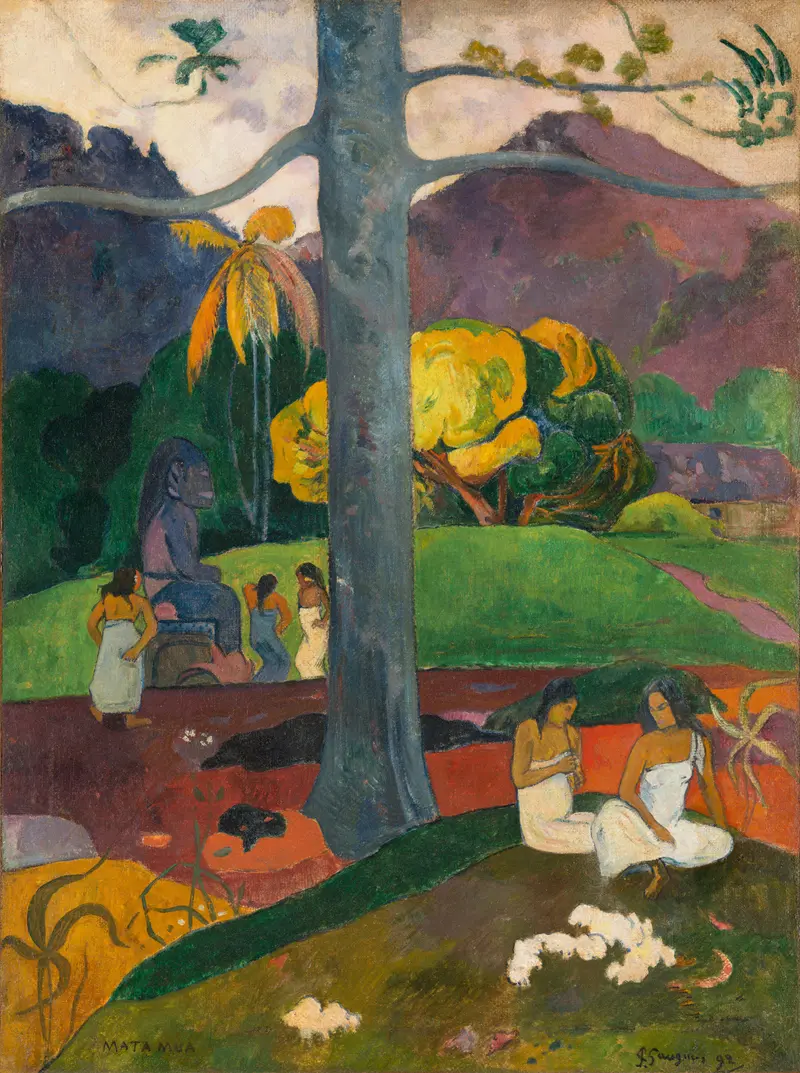
Mata Mua
Paul Gauguin





