
Where Do We Come From? What Are We? Where Are We Going? — History & Facts
A long frieze of figures of all ages is spread across a tropical landscape of dark blue trees and bare ground. At the far right a baby lies asleep on the ground, with three women huddled near it; in the center a nearly nude figure in yellow stands with both arms raised, reaching for a piece of fruit. Behind, at the left, a blue idol with raised arms stands on a stone base, and at the far left a crouching old woman with her head on her hand sits beside a white bird. No figure is a named sitter.
Paul Gauguin painted it in Tahiti in 1897–1898, and it is the largest painting he ever attempted. As he explained, it is read from right to left, from the sleeping infant to an old woman nearing death. In February 1898 he told a friend he had decided to die but first wished to paint this canvas, working day and night for a month; afterward he went into the mountains with arsenic, but survived. Gauguin chose a coarse burlap and smooth paint for a fresco-like effect.
It first went on view in Paris in 1898 at Ambroise Vollard's gallery. It is in the Museum of Fine Arts in Boston.
Sources: Museum of Fine Arts Boston, record 36.270 · Wikidata Q890678 · Wikipedia: Where Do We Come From? What Are We? Where Are We Going? · Image source (Wikimedia Commons)
More Artworks by Paul Gauguin

Self Portrait
Paul Gauguin

Three Tahitian Women
Paul Gauguin

When Will You Marry?
Paul Gauguin

Merahi metua no Tehamana
Paul Gauguin

Nave Nave Mahana
Paul Gauguin

Fatata te Miti (By the Sea)
Paul Gauguin

Three Tahitians
Paul Gauguin

Breton Girls Dancing,Pont-Aven
Paul Gauguin

Nave Nave Fenua
Paul Gauguin
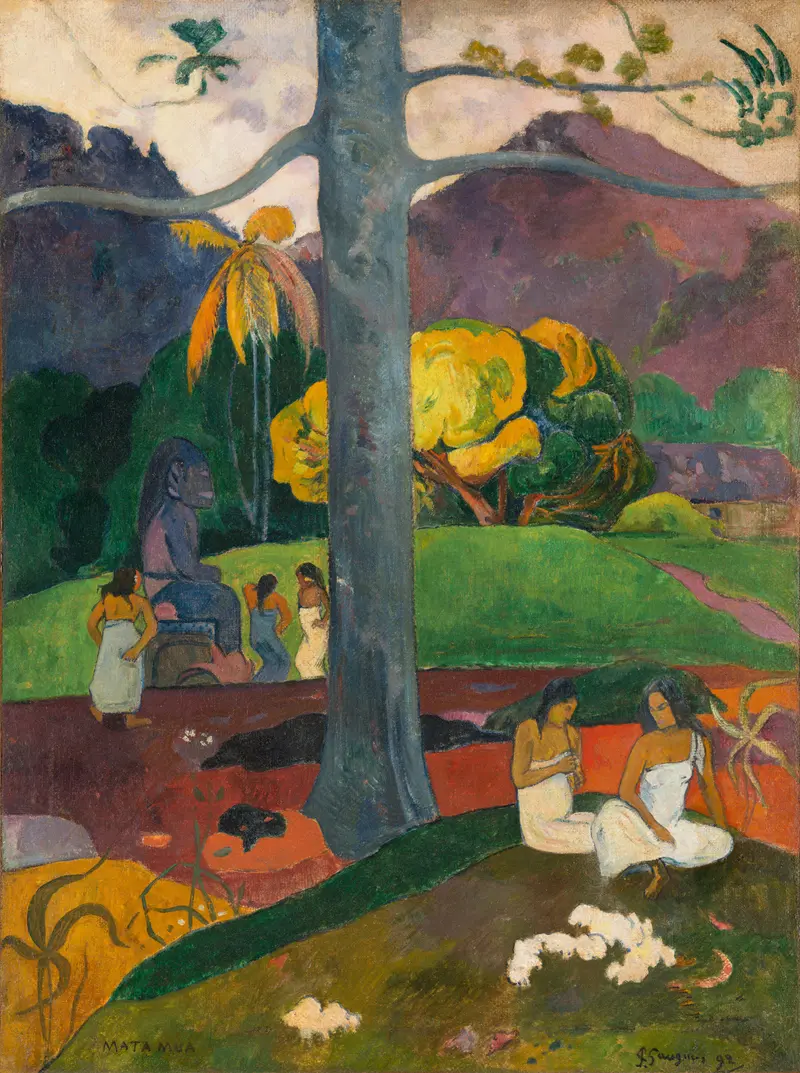
Mata Mua
Paul Gauguin
More Genre Scene Art

Banquet of the Officers of the St George Civic Guard
Frans Hals

Rembrandt and Saskia in the Scene of the Prodigal Son
Rembrandt van Rijn

Bal du moulin de la Galette
Pierre-Auguste Renoir

Quadrille at the Moulin Rouge
Henri de Toulouse-Lautrec

A Burial at Ornans
Gustave Courbet
When Will You Marry?
Paul Gauguin