Street Cafes — History & Facts
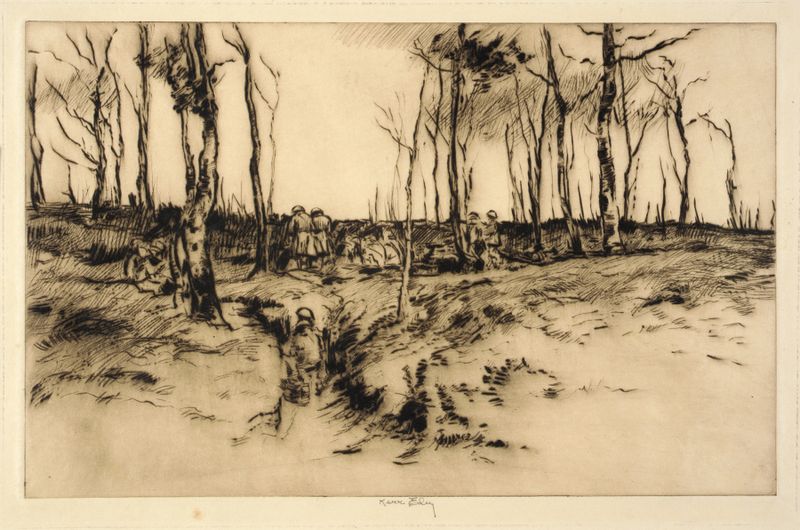
Could beauty survive in a century of chaos? In Street Cafes, Kerr Eby captures the delicate balance between tranquility and the underlying grief of a post-war world. Look to the left, where a couple sits closely at a quaint table, their features softened by the warm, golden light filtering through the trees. The rich blues and muted earth tones create an inviting ambiance, drawing the viewer into this intimate moment. The careful brushwork highlights not just the scene's stillness but also the subtle movements of conversation—the slight lean of the woman, the gentle gesture of the man’s hand, as if caught mid-laugh.
This interplay of light and shadow not only conveys warmth but also hints at the fleeting quality of joy, a contrast to the shadows of loss that linger just outside the frame. The juxtaposition of the bustling street in the background with the serene café foreground reveals deeper emotional tensions. The vibrancy of life beyond the café exudes energy, yet there is an air of nostalgia, perhaps mourning lost connections and the scars of recent conflict. The figures, seemingly detached from the chaos, reflect a yearning for normalcy—perhaps an oasis of peace amidst a world grappling with grief. Kerr Eby created Street Cafes in 1924, during a time when many artists were responding to the physical and emotional scars left by World War I.
Living in New York, Eby was influenced by the city's energy and its art communities, which were increasingly exploring themes of everyday life and the human condition. This period was marked by a shift towards modernism, yet Eby retained a sensitivity to the past, threading it seamlessly into his observations of contemporary life.